

Why Am I Gaining Weight When I Am Stressed? Cortisol, Sleep, Blood Sugar and Appetite Explained

You have not changed what you eat. You are not eating more than usual. You are walking, maybe even working out. And somehow the number on the scale is creeping up anyway. Or your clothes are fitting differently. Or there is weight around your middle that was not there before and nothing you try seems to shift it.
And on top of all of that, you are exhausted and overwhelmed.
If this sounds familiar, you are not imagining it. And it is not a willpower problem. Chronic stress changes the chemistry of your body in specific, measurable ways that make weight gain more likely and weight loss harder, regardless of what you are eating. The answer is not another diet. It is understanding what is actually happening inside your body when stress has been present for too long.
This post explains all of it.
This Is Not About Willpower
Before we go any further, let us say this clearly.
If you are gaining weight during a stressful season of life despite trying to eat well, that is not a character flaw. It is not laziness. It is not weakness. It is physiology.
Stress raises our cortisol levels, which increases insulin production. The resulting blood sugar changes make us crave sugary, fatty foods. A 2015 study found that metabolism is slower when we are stressed. A 2007 study found that high cortisol levels may actually enhance the feeling of satisfaction we experience when eating high-fat, sugary foods.
Your body is doing exactly what it is designed to do under sustained threat. Understanding that is the first step to actually changing it.
What Cortisol Is and Why It Matters for Your Weight
Cortisol is your primary stress hormone. It is produced by your adrenal glands and released in response to any form of stress, whether that is a deadline at work, an argument with your partner, a blood sugar crash, a bad night of sleep, too much caffeine, or years of pushing your body past its limits.
In small, short-term doses, cortisol is useful. It gives you energy, sharpens your focus, and helps your body respond to challenges. The problem is not cortisol itself. The problem is what happens when stress is ongoing and cortisol never fully comes back down.
Chronically elevated cortisol levels can keep blood sugar high and lead to insulin resistance. This means the body has a harder time using sugar for energy, which can lead to weight gain.
Cortisol also affects where your body stores fat. Chronic stress and high cortisol can affect fat storage and contribute to the buildup of abdominal fat, which is the harder-to-lose, more metabolically active fat that accumulates around the waist and organs.













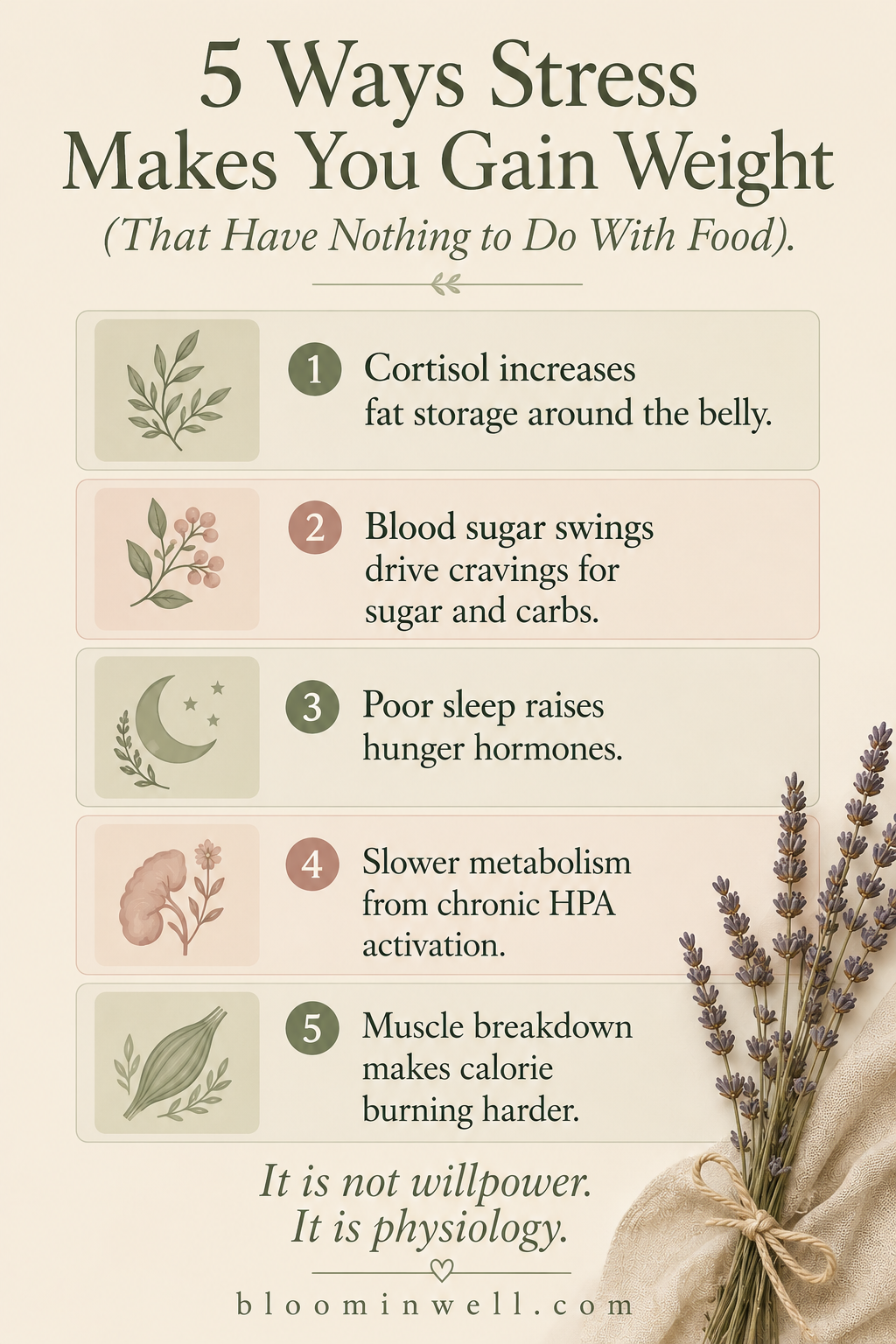
The Five Ways Chronic Stress Drives Weight Gain
1. Cortisol Increases Hunger and Cravings
Elevated cortisol levels boost appetite, particularly cravings for high-calorie, sugary, and fatty foods. This is not random. When your body perceives a threat, it wants energy-dense food. It is a survival mechanism.
The problem is that most modern stress is not physical. You are not running from a predator. You are managing a demanding job, raising children, and navigating a hundred emotional demands simultaneously. But your body is responding as if it needs fuel to survive something physical. The result is intense cravings for carbohydrates, sugar, and fat that feel completely out of your control, because at the hormonal level, they partly are.
High cortisol levels are linked to increased appetite and cravings for calorie-dense foods, particularly those high in sugar and fat, which activate reward circuitry during stressful periods.
2. Blood Sugar Swings Make Everything Worse
Cortisol raises blood sugar by triggering the liver to release stored glucose. This made sense when stress meant physical danger. Your muscles needed immediate fuel. But when the stress is emotional or psychological, that glucose has nowhere to go. Insulin is released to manage it. Blood sugar drops. And then you are hungry again and craving something sweet, even though you ate an hour ago.
This blood sugar roller coaster repeats throughout the day when chronic stress is present. Each cycle adds to insulin resistance over time. And insulin resistance makes fat storage easier and fat burning harder.
3. Poor Sleep Raises Your Hunger Hormones
Stress and poor sleep are completely intertwined, and both drive weight gain through the same hormonal pathways.
When you do not sleep well, your body produces more ghrelin, the hunger hormone that tells you to eat, and less leptin, the satiety hormone that tells you to stop. This means the day after a poor night of sleep, you are measurably hungrier, you need more food to feel full, and you are more likely to crave carbohydrates and sugar specifically.
This creates a cycle where stress affects sleep, poor sleep affects appetite, and appetite changes affect weight.
Chronic stress sets off a chain reaction: elevated cortisol leads to poor sleep, poor sleep raises hunger hormones, and elevated hunger hormones drive cravings and appetite the next day.
Read more: Why You Are Exhausted Even After Sleeping 8 Hours
4. Your Metabolism Slows Down
Research has consistently shown that chronic stress slows resting metabolic rate. Your body, sensing prolonged threat, conserves energy rather than burning it. It prioritizes survival functions over everything else. This means that even if your calorie intake stays exactly the same as it was before your stressful period began, your body is burning through those calories more slowly.
This is one of the most frustrating and least-discussed aspects of stress-related weight gain. You did not do anything differently. Your body did.
5. Muscle Breaks Down More Quickly
Cortisol is catabolic, meaning it breaks down tissues, including muscle tissue. When cortisol is chronically elevated, your body preferentially burns muscle for fuel rather than protecting it. Less muscle means a slower resting metabolism, because muscle is metabolically active tissue that burns calories even at rest.
This is why women who are under sustained chronic stress, particularly those who are also restricting calories or doing excessive cardio, can find themselves losing muscle and gaining fat simultaneously, even when the scale does not move much.
Why Belly Fat Is a Stress Symptom
If you have noticed new weight accumulating specifically around your middle, this is not coincidental.
Cortisol directs fat storage toward abdominal and visceral fat, the fat that surrounds the organs. This happens because abdominal fat cells have more cortisol receptors than fat cells in other areas of the body, making them particularly responsive to cortisol-driven fat storage.
Visceral belly fat is also more hormonally active than fat stored elsewhere. It produces inflammatory cytokines, converts androgens to estrogen, and contributes to the insulin resistance that makes the entire cycle harder to break.
This is why the combination of chronic stress, poor sleep, and blood sugar dysregulation tends to produce a very specific pattern: weight gain around the middle that is resistant to conventional diet and exercise approaches, because the root cause is hormonal, not caloric.
Read more: Is It Perimenopause or Chronic Stress?
Why Eating Less and Exercising More Often Makes It Worse
This is the counterintuitive part that most wellness advice completely misses.
When you are in chronic stress, undereating is itself a stressor. Your body interprets caloric restriction as a threat. Cortisol rises further. Muscle breakdown accelerates. Metabolism slows more. The pattern intensifies.
High-intensity exercise during chronic stress has the same effect. These can come from emotional stress, poor sleep, under-eating, over-exercising, blood sugar swings, illness, pain, alcohol, too much caffeine, or simply living in a constant state of rushing.
Adding hard workouts to an already cortisol-elevated system raises cortisol further. For women in HPA axis burnout or nervous system dysregulation, intense exercise can actively worsen the hormonal picture.
The approach that actually works is different from what you have probably been told. Stable blood sugar. Adequate protein. Restorative rather than punishing movement. Sleep protected as a priority. Nervous system regulation as a daily practice. And targeted nutritional support for the specific systems under stress.
Read more: What to Eat When Your Nervous System Is Dysregulated
What Actually Helps
Stabilize Your Blood Sugar First
This is the highest-leverage starting point. When blood sugar is stable, cortisol spikes from blood sugar crashes are eliminated. Cravings diminish. Energy evens out. The hormonal roller coaster quiets.
Protein at every meal is the most effective single dietary change for blood sugar stability. Aim for 25 to 40 grams per meal. Add fat and fiber to every eating occasion. Avoid long gaps between meals that allow blood sugar to drop significantly.
Avoid starting your day with caffeine on an empty stomach. Coffee raises cortisol directly, and doing so without food amplifies the morning cortisol response that is already elevated in stressed women.
Read more: Why High Protein Calms Anxiety
Protect Sleep Like It Is the Job
Poor sleep raises hunger hormones. It slows metabolism. It elevates cortisol. It impairs every decision you will make about food the next day.
Prioritizing sleep is not optional for women dealing with stress-related weight gain. It is one of the most metabolically significant things you can do. Consistent wake and sleep times. A dark, cool room. No screens in the 60 minutes before bed. Magnesium glycinate before bed to support GABA activity and sleep architecture.
Read more: Minerals for Better Sleep and Why You Wake Up at 3am
Choose Restorative Movement
Walking is one of the most underrated metabolic tools available. It lowers cortisol, improves insulin sensitivity, supports lymphatic drainage, and does not add a stress burden to an already stressed system.
If you enjoy strength training, gentle progressive resistance work supports muscle preservation without spiking cortisol the way high-intensity cardio does for women in burnout. The goal is movement that leaves you feeling better, not more depleted.
Regulate Your Nervous System Daily
This is the upstream intervention that the conventional conversation about stress and weight gain almost never addresses.
If your nervous system stays in chronic sympathetic activation, cortisol stays elevated, and every downstream effect continues. Daily nervous system regulation practices, including extended exhale breathing, gentle movement, somatic tools, and sufficient rest, address the root of the hormonal pattern rather than just its symptoms.
Read more: 12 Things That Help Calm an Overstimulated Nervous System
Read more: Why You Feel Worse After Resting
My Foundational Stress Support Stack
These are the supplements I return to most often when supporting women navigating stress-related weight changes. They are not quick fixes. They work by addressing the underlying hormonal and metabolic disruption that makes stress-related weight gain so persistent.
Magnesium glycinate — supports cortisol regulation, blood sugar stability, sleep architecture, and the nervous system response to stress. The most foundational supplement for this pattern.
Omega-3 fatty acids — reduce systemic inflammation, support cortisol regulation, and improve insulin sensitivity. Chronic stress depletes omega-3 stores, and low omega-3 status is associated with worsened cortisol reactivity and mood instability.
High-quality protein powder — for days when cooking is not happening and protein intake would otherwise drop below what supports blood sugar stability and muscle preservation. A complete protein source with minimal ingredients.
Fiber supplement — supports blood sugar stability by slowing glucose absorption, feeds beneficial gut bacteria, and reduces the cortisol-driven appetite swings that make consistency difficult. Psyllium husk or acacia fiber added to morning water is a simple daily addition.
Adaptogenic herbs for cortisol support — ashwagandha for the wired-and-anxious pattern where cortisol is chronically elevated. Rhodiola for the depleted-but-still-pushing pattern. Both require 6 to 8 weeks of consistent use before their effects become apparent.
Magnesium L-threonate — if brain fog, cognitive fatigue, and poor sleep quality are significantly compounding the stress picture, adding threonate to support brain magnesium levels is worth considering alongside glycinate.
Light therapy lamp — morning light exposure is one of the most powerful cortisol rhythm regulators available. A 10,000 lux lamp used for 20 to 30 minutes within an hour of waking helps retrain the morning cortisol awakening response, which improves energy, mood, and metabolic function throughout the day.
Get a 10000 Lux Light Therapy Wake-Up Lamp here →
A walking pad or under-desk treadmill — for women whose schedules make intentional movement difficult. Low-intensity walking throughout the workday lowers cortisol, improves insulin sensitivity, and supports mood without adding a stress burden to an already depleted system.
Get a walking pad for your at home office here →
The Bottom Line
Yes, stress causes weight gain. Not because you lack discipline, but because cortisol, insulin, hunger hormones, sleep disruption, and metabolic slowdown all shift in directions that make weight gain more likely and weight loss harder during sustained periods of chronic stress.
The answer is not to eat less and push harder. For women in chronic stress, that approach often makes the hormonal picture worse. The answer is to address the root: blood sugar stability, sleep quality, nervous system regulation, adequate protein, restorative movement, and targeted nutritional support for the systems that chronic stress depletes first.
Your body is not working against you. It is responding to a signal. Change the signal, and the body changes with it.
Read more: Why You Feel Worse Before Your Period
Read more: What to Eat When Your Nervous System Is Dysregulated
Sources
Cleveland Clinic. You Guessed It: Long-Term Stress Can Make You Gain Weight. 2023. https://health.clevelandclinic.org/stress-and-weight-gain
Healthline. Cortisol and Weight Gain: Is There a Connection? https://www.healthline.com/nutrition/cortisol-and-weight-gain
Dallman MF. Stress-induced obesity and the emotional nervous system. Trends in Endocrinology and Metabolism. 2010;21(3):159–165. https://pubmed.ncbi.nlm.nih.gov/19926299/
Epel ES, et al. Stress may add bite to appetite in women: a laboratory study of stress-induced cortisol and eating behavior. Psychoneuroendocrinology. 2001;26(1):37–49. https://pubmed.ncbi.nlm.nih.gov/11070333/
Taheri S, et al. Short sleep duration is associated with reduced leptin, elevated ghrelin, and increased body mass index. PLoS Medicine. 2004;1(3):e62. https://pubmed.ncbi.nlm.nih.gov/15602591/
Björntorp P. Do stress reactions cause abdominal obesity and comorbidities? Obesity Reviews. 2001;2(2):73–86. https://pubmed.ncbi.nlm.nih.gov/12119665/
Hewagalamulage SD, et al. Stress, cortisol, and obesity: a role for cortisol responsiveness in identifying individuals prone to obesity. Domestic Animal Endocrinology. 2016;56 Suppl:S112–S120. https://pubmed.ncbi.nlm.nih.gov/27345309/
DMV Weight Loss. Why Stress Makes You Gain Weight Even When You Are Not Eating More. 2026. https://www.dmvweightloss.com/why-stress-makes-you-gain-weight-even-when-youre-not-eating-more/
BSW Health. Cortisol Belly: How Stress Can Impact Your Weight. https://www.bswhealth.com/blog/cortisol-belly-how-stress-can-impact-your-weight-and-what-you-can-do-about-it
National Institute of Diabetes and Digestive and Kidney Diseases. Insulin Resistance and Prediabetes. https://www.niddk.nih.gov/health-information/diabetes/overview/what-is-diabetes/prediabetes-insulin-resistance