

Magnesium Glycinate for Women: Benefits, Dosage, Side Effects and What to Look For

If you have spent any time in wellness spaces recently, you have probably heard that magnesium glycinate is something you should be taking. Maybe a friend mentioned it. Maybe you saw it on social media. Maybe your doctor casually suggested it and then gave you zero guidance on what to buy.
You are not imagining the buzz. Magnesium glycinate is one of the most searched supplement terms of 2026, with particular growth in searches around sleep and anxiety support for women. And the interest is not just trend-driven. There is real science behind it.
But here is what most articles skip: magnesium glycinate is one form of magnesium among many. And the form you choose matters a great deal, depending on what you are trying to address. Taking the wrong form is often why women try magnesium, feel nothing, and conclude that supplements just don't work for them.
This post gives you the complete picture. What magnesium glycinate actually does, who it helps most, what the research says, how much to take, what side effects to watch for, and what to look for before you buy anything.
What Is Magnesium Glycinate?
Magnesium glycinate is magnesium bound to glycine, an amino acid. This binding process is called chelation. It makes the magnesium more stable in the digestive tract and significantly more bioavailable than cheaper, unbonded forms like magnesium oxide.
Glycine itself is not just a delivery vehicle. It has its own calming properties. Glycine acts as an inhibitory neurotransmitter in the brain and spinal cord, meaning it helps quiet overexcited neurons. When you take magnesium glycinate, you are essentially getting two calming compounds working together.
You will sometimes see it called magnesium bisglycinate on labels. These are the same thing. Bisglycinate means the magnesium is bound to two glycine molecules rather than one, which is slightly more stable and has the same therapeutic effect.
Why So Many Women Are Low in Magnesium
Before we talk about what magnesium glycinate does for you, it helps to understand why deficiency is so common.
Magnesium is involved in over 300 enzymatic reactions in the body. It supports nervous system function, hormone production, sleep regulation, muscle relaxation, blood sugar balance, and energy production. Your body burns through it constantly.
Chronic stress is the fastest route to depletion. Every cortisol response requires magnesium. Women living with burnout, overwhelm, or ongoing stress are depleting their magnesium stores faster than diet can replace them.
Modern diets compound the problem. Processed foods contain virtually no magnesium. Soil depletion over the past century means that even whole foods contain less magnesium than they once did. Coffee and alcohol both increase urinary magnesium excretion. Common medications including proton pump inhibitors, diuretics, and metformin deplete it further.
The result is that a significant number of women are living with suboptimal magnesium levels without ever being told about it. Standard serum magnesium tests are not a reliable indicator of cellular magnesium status. Your blood level can appear normal while your tissues are running low.











What Magnesium Glycinate Actually Does
Sleep
This is where the research on magnesium glycinate is strongest.
A 2025 randomized, double-blind, placebo-controlled trial published in Nature and Science of Sleep found that 250 mg of elemental magnesium bisglycinate significantly reduced Insomnia Severity Index scores within four weeks compared to placebo. The benefit was most pronounced in people with low dietary magnesium intake, which, as we covered above, describes most women.
How does it work? Magnesium supports the activity of GABA receptors in the brain. GABA is your primary inhibitory neurotransmitter. It is the chemical signal that tells your brain it is safe to quiet down. Without adequate magnesium, GABA signaling is impaired. The result is a nervous system that stays in low-level activation even when you are in bed, leading to difficulty falling asleep, staying asleep, or feeling rested when you wake up.
Magnesium also regulates melatonin production, the hormone that governs your sleep-wake cycle. Low magnesium disrupts melatonin timing. Supporting magnesium status supports the entire hormonal foundation of sleep.
If you are waking up at 3am, lying awake with racing thoughts, or waking unrefreshed despite eight hours, magnesium glycinate is often one of the most impactful first steps.
Read more: Why You're Exhausted Even After Sleeping 8 Hours
Anxiety and Nervous System Regulation
Magnesium is directly involved in the regulation of the HPA axis, the system that governs your stress response. When magnesium is low, the stress response becomes dysregulated. Cortisol rises more easily, takes longer to come back down, and the nervous system stays in a low-level state of alert that feels like background anxiety.
Research consistently associates low magnesium status with higher rates of anxiety and mood instability. A review published in Nutrients found that magnesium supplementation had a meaningful positive effect on mild to moderate anxiety in clinical studies.
Magnesium glycinate is particularly suited for anxiety support because the glycine component has independent calming effects at the central nervous system level. Together they provide a gentle but consistent signal to the nervous system that it is safe to calm down.
If your anxiety has a physical quality to it, muscle tension, chest tightness, jaw clenching, difficulty taking a full breath, these are often signs of magnesium deficiency rather than purely psychological anxiety.
Read more: 12 Things That Help Calm an Overstimulated Nervous System
Muscle Tension and Cramps
Magnesium governs muscle relaxation. Calcium causes muscles to contract. Magnesium causes them to release. When magnesium is low, muscles stay in a contracted state. You feel it as tightness in the neck and shoulders, jaw clenching, leg cramps at night, restless legs, and that general feeling of physical tension that never fully lets go.
This is particularly relevant for women with PMS-related cramping. Magnesium deficiency is associated with increased prostaglandin activity, which intensifies uterine cramping. Multiple studies have found that magnesium supplementation reduces menstrual pain and PMS symptoms.
Read more: Why You Feel Worse Before Your Period
Hormone Balance and PMS
Progesterone production requires magnesium. Magnesium is also needed for healthy estrogen metabolism through the liver. Women with PMS, PMDD, or significant perimenopause symptoms are frequently found to be magnesium deficient, and their symptoms often improve meaningfully with consistent supplementation.
Beyond direct hormone synthesis, magnesium supports the liver's ability to clear estrogen efficiently. When liver detoxification pathways are impaired by low magnesium, estrogen recirculates in the body instead of being excreted. This contributes to the estrogen dominance pattern that drives heavy periods, PMS, breast tenderness, and mood swings.
Read more: Estrogen Dominance Decoded
Blood Sugar and Metabolic Health
Magnesium plays a central role in insulin signaling. It is required for insulin receptors to function properly. Low magnesium is associated with insulin resistance and higher fasting blood sugar. For women dealing with blood sugar dysregulation, PCOS, or metabolic concerns, magnesium glycinate supports the foundational metabolic machinery.
It also helps prevent the blood sugar crashes that trigger cortisol release and worsen nervous system dysregulation. For anxious women who crash in the afternoon, addressing magnesium alongside meal structure is often the combination that finally shifts the pattern.
Read more: What to Eat When Your Nervous System Is Dysregulated
Constipation (A Note on Forms)
If your goal is gut motility support, magnesium glycinate is not your best choice. That is what magnesium citrate is for. Glycinate is gentle on the digestive system by design, meaning it does not have the laxative effect that citrate provides. If you are taking magnesium glycinate hoping it will help with constipation, you may be disappointed. Choose citrate for that specific goal.



Magnesium Glycinate vs. Other Forms
Here is a plain-language comparison of the most common forms.
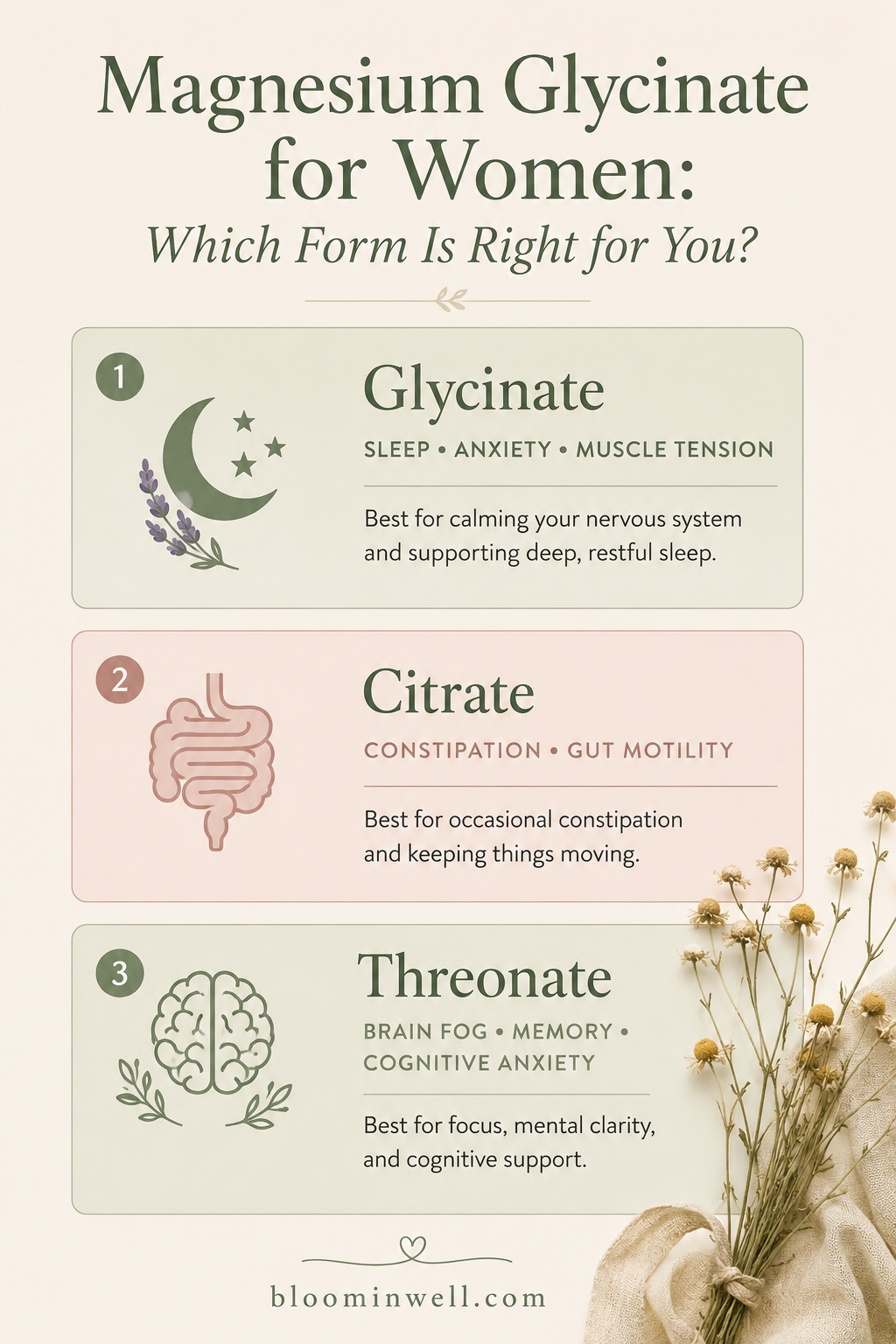
Magnesium glycinate or bisglycinate: Best for sleep, anxiety, nervous system regulation, muscle tension, PMS, and hormone balance. Gentle on the stomach. Best for daily long-term use. Recommended starting point for most women.
Magnesium citrate: Best for constipation and occasional sleep support at lower doses. Has a mild laxative effect. Common in powder drink mixes. Not ideal for daily use if digestive effects are a concern.
Magnesium L-threonate: Best for brain fog, memory, cognitive anxiety, and age-related cognitive concerns. The only form studied for its ability to cross the blood-brain barrier. More expensive. Lower elemental magnesium content per dose. Worth adding if brain-related symptoms are your primary concern.
Magnesium malate: Best for fatigue and chronic pain conditions, including fibromyalgia. Contains malic acid, which supports mitochondrial energy production.
Magnesium oxide: Avoid this one. It is poorly absorbed, primarily functions as a laxative, and is the form found in most cheap multivitamins. If you have tried magnesium and felt nothing, this is almost certainly what you were taking.
Magnesium Glycinate Dosage for Women
The research on magnesium bisglycinate for sleep used 250 mg of elemental magnesium. Most clinical studies on magnesium for anxiety and sleep use between 200 and 400 mg of elemental magnesium daily.
Pay attention to the distinction between the weight of the compound and the elemental magnesium content. A capsule labeled 400 mg magnesium glycinate may only contain 50 to 60 mg of elemental magnesium, depending on the formulation. Check the label carefully and make sure you are dosing based on elemental magnesium.
Starting dose: 200 mg of elemental magnesium glycinate before bed. Give your body two weeks at this dose before increasing.
Maintenance dose: 200 to 400 mg of elemental magnesium daily. Most women find their ideal dose through gradual increase and monitoring of sleep quality, muscle tension, and morning mood.
Timing: Take 30 to 60 minutes before bed for sleep and nervous system support. This aligns with the GABA-supporting effects at the time when they are most needed.
Side Effects of Magnesium Glycinate
Magnesium glycinate is one of the most well-tolerated supplement forms available. The most common reason women experience side effects from magnesium is because they are taking a poorly absorbed form like oxide. Glycinate rarely causes digestive upset.
Loose stools: Unusual with glycinate at normal doses, but possible if you are taking very high doses. If this happens, reduce your dose.
Morning grogginess: Some women find that higher doses taken before bed leave them feeling heavy in the morning. If this happens, try taking a slightly earlier or reduce your dose. A small number of women do better splitting their dose between afternoon and evening rather than taking it all at once before bed.
Low blood pressure: Magnesium has mild blood pressure-lowering effects. If you are already on blood pressure medication or tend toward low blood pressure, monitor accordingly and discuss with your prescribing doctor.
Kidney considerations: The kidneys regulate magnesium excretion. If you have kidney disease or reduced kidney function, consult your doctor before supplementing with magnesium in any form.
Drug interactions: Magnesium can reduce the absorption of certain antibiotics, bisphosphonates for osteoporosis, and some thyroid medications. Separate magnesium from these medications by at least two hours.
What to Look for When Buying Magnesium Glycinate
The supplement market is not regulated the same way medications are. This means quality varies enormously between brands. Here is what matters.
The label should say magnesium glycinate or magnesium bisglycinate specifically. "Chelated magnesium" alone is not enough information. The amino acid it is bound to determines the therapeutic effect.
Third-party testing. Look for NSF Certified, USP Verified, or Informed Sport certification on the label. These mean an independent organization has verified that the product contains what it says and is free from contaminants.
Elemental magnesium content should be clearly listed. If the label only lists the total compound weight and not the elemental magnesium, that is a red flag. You cannot dose appropriately without knowing how much elemental magnesium is in each capsule.
Minimal other ingredients. A clean magnesium glycinate supplement should not need artificial colors, synthetic preservatives, silicon dioxide, or titanium dioxide. Look for the shortest, cleanest ingredient list possible.
Practitioner-grade brands. Products available through platforms like Fullscript have gone through more rigorous quality screening than most products on retail shelves.
What I look for in a magnesium supplement:
Third-party tested, elemental magnesium clearly labeled, magnesium bisglycinate specifically stated, no artificial colors or preservatives, and a brand with a track record in functional medicine practice.
Take a look at these options:
Can You Get Enough Magnesium From Food?
Yes, in theory. In practice, most women do not.
The richest food sources of magnesium are pumpkin seeds (one ounce provides 37% of the daily value), dark chocolate at 70% or higher, almonds, cashews, black beans, spinach, avocado, and banana. Whole grains also contribute meaningful amounts.
If you are eating large quantities of these foods consistently, your dietary magnesium may be adequate. But for women under chronic stress, with gut absorption issues, or taking medications that deplete magnesium, supplementation fills a gap that food cannot reliably close.
How Long Before You Notice a Difference?
Magnesium is not a supplement that produces an immediate dramatic effect, unless you had a very acute deficiency. It works cumulatively as your cellular magnesium stores replenish over weeks.
Most women notice meaningful improvements in sleep quality, muscle tension, and morning mood within two to six weeks of consistent daily use. Four weeks is a reasonable minimum trial period before drawing conclusions.
If you have been consistently supplementing for six weeks and notice no change, consider whether you are taking an adequate elemental dose, whether your gut absorption may be impaired, and whether another root cause is primarily driving your symptoms.
Who Should Talk to a Doctor First?
Magnesium glycinate is safe and well-tolerated for most healthy women. But please discuss with your doctor before starting if you have kidney disease or reduced kidney function, take medications for blood pressure or heart rhythm, take thyroid medications or bisphosphonates, or are pregnant or breastfeeding.
The Bottom Line
Magnesium glycinate is one of the most practically useful and consistently underappreciated supplements for women. The research on its role in sleep quality, nervous system regulation, anxiety, muscle tension, PMS, and hormone balance is genuinely strong. The form is gentle, well-absorbed, and appropriate for long-term daily use.
For most women dealing with anxiety, poor sleep, muscle tension, or nervous system dysregulation, magnesium glycinate is the most evidence-informed starting point available. Start at 200 mg of elemental magnesium before bed. Give it six weeks. Notice what shifts.
Your body has been trying to tell you what it needs. This might be it.
Read more: Minerals for Better Sleep and Why You Wake Up at 3am
Read more: The Best Magnesium for Women: Glycinate vs Citrate vs Threonate
Sources
Schuster J, et al. Magnesium Bisglycinate Supplementation in Healthy Adults Reporting Poor Sleep: A Randomized, Placebo-Controlled Trial. Nature and Science of Sleep. 2025. https://pubmed.ncbi.nlm.nih.gov/40918053/
Boyle NB, Lawton C, Dye L. The Effects of Magnesium Supplementation on Subjective Anxiety and Stress. Nutrients. 2017;9(5):429. https://www.ncbi.nlm.nih.gov/pmc/articles/PMC5452159/
Lopresti AL, Smith SJ. Magnesium L-Threonate and Cognitive Performance and Sleep Quality. Frontiers in Nutrition. 2026. https://www.frontiersin.org/journals/nutrition/articles/10.3389/fnut.2025.1729164/full
Hausenblas HA, et al. Magnesium-L-Threonate Improves Sleep Quality and Daytime Functioning. Sleep Medicine: X. 2024. https://pubmed.ncbi.nlm.nih.gov/39252819/
DiNicolantonio JJ, O'Keefe JH, Wilson W. Subclinical magnesium deficiency: a principal driver of cardiovascular disease and a public health crisis. Open Heart. 2018. https://openheart.bmj.com/content/5/1/e000668
Kirkland AE, Sarlo GL, Holton KF. The Role of Magnesium in Neurological Disorders. Nutrients. 2018;10(6):730. https://www.ncbi.nlm.nih.gov/pmc/articles/PMC6024559/
Fang X, et al. Dietary Magnesium Intake and the Risk of Depression. Journal of Affective Disorders. 2018. https://pubmed.ncbi.nlm.nih.gov/29241421/
National Institutes of Health Office of Dietary Supplements. Magnesium Fact Sheet for Health Professionals. https://ods.od.nih.gov/factsheets/Magnesium-HealthProfessional/
Gröber U, Schmidt J, Kisters K. Magnesium in Prevention and Therapy. Nutrients. 2015;7(9):8199–8226. https://www.ncbi.nlm.nih.gov/pmc/articles/PMC4586582/
ConsumerLab. Magnesium Supplement Review. 2026. https://www.consumerlab.com/reviews/magnesium-supplements/magnesium/