

Why Stress Keeps Showing Up in Your Body Instead of Your Head

You are not falling apart. But your body is doing something your mind refuses to acknowledge, and that disconnect is exactly why you end up in a doctor's office with a list of physical complaints and no explanation that makes sense.
Chronic stress showing up in your body instead of your head is not a character flaw or a weakness. It is a deeply wired biological response, and for a lot of women in their 30s and 40s, it is the primary reason their health feels like it is quietly unraveling while they are still technically functioning.
This post is about why that happens, what it actually looks like, and what your body is trying to communicate when it keeps throwing symptoms at you that nobody can explain.
Your Brain Learned to Skip the Feelings and Go Straight to the Symptoms
Here is what most people assume: stress is something you feel emotionally. You feel worried, overwhelmed, anxious. And then, maybe, that bleeds into some physical tension.
That is not how it works for most chronically stressed women.
For many of you, the emotional experience of stress has been muted for years. You have been managing, coping, carrying, and pushing through for so long that your nervous system stopped asking permission. It just started doing what stress does, physiologically, without waiting for your emotional awareness to catch up.
The Nervous System Does Not Distinguish Between a Deadline and a Lion
Your autonomic nervous system, specifically the sympathetic branch, activates in response to any perceived threat. That threat does not have to be physical danger. It can be an email from your boss at 9pm. It can be a hard conversation you have been avoiding. It can be the quiet background hum of not having enough time, money, margin, or rest.
When that sympathetic activation happens, your body responds the same way it would to a predator. Cortisol and adrenaline are released. Blood is directed away from digestion and toward your muscles. Inflammation increases. Your immune system is briefly suppressed. Your reproductive hormones take a backseat.
This is not a malfunction. This is your nervous system doing exactly what it was designed to do. The problem is that it was designed for acute threats that resolve, not the kind of relentless low-grade pressure that defines modern life for women holding everything together.
When Stress Becomes Chronic, the Body Becomes the Messenger
When stress is sustained over weeks, months, or years, the physiological effects accumulate. And because the emotional signal has often been numbed or overridden, the body starts communicating in the only language it has left: symptoms.
Tension headaches. Digestive issues. A cycle that shifts or disappears. Skin that suddenly rebels. Fatigue that sleep does not fix. A racing heart at 2am. Muscle tightness that lives in your jaw, your shoulders, your hips.
None of these feel like stress. They feel like something is wrong with your body. Which is why you end up chasing diagnoses instead of addressing what is actually driving the symptoms.





















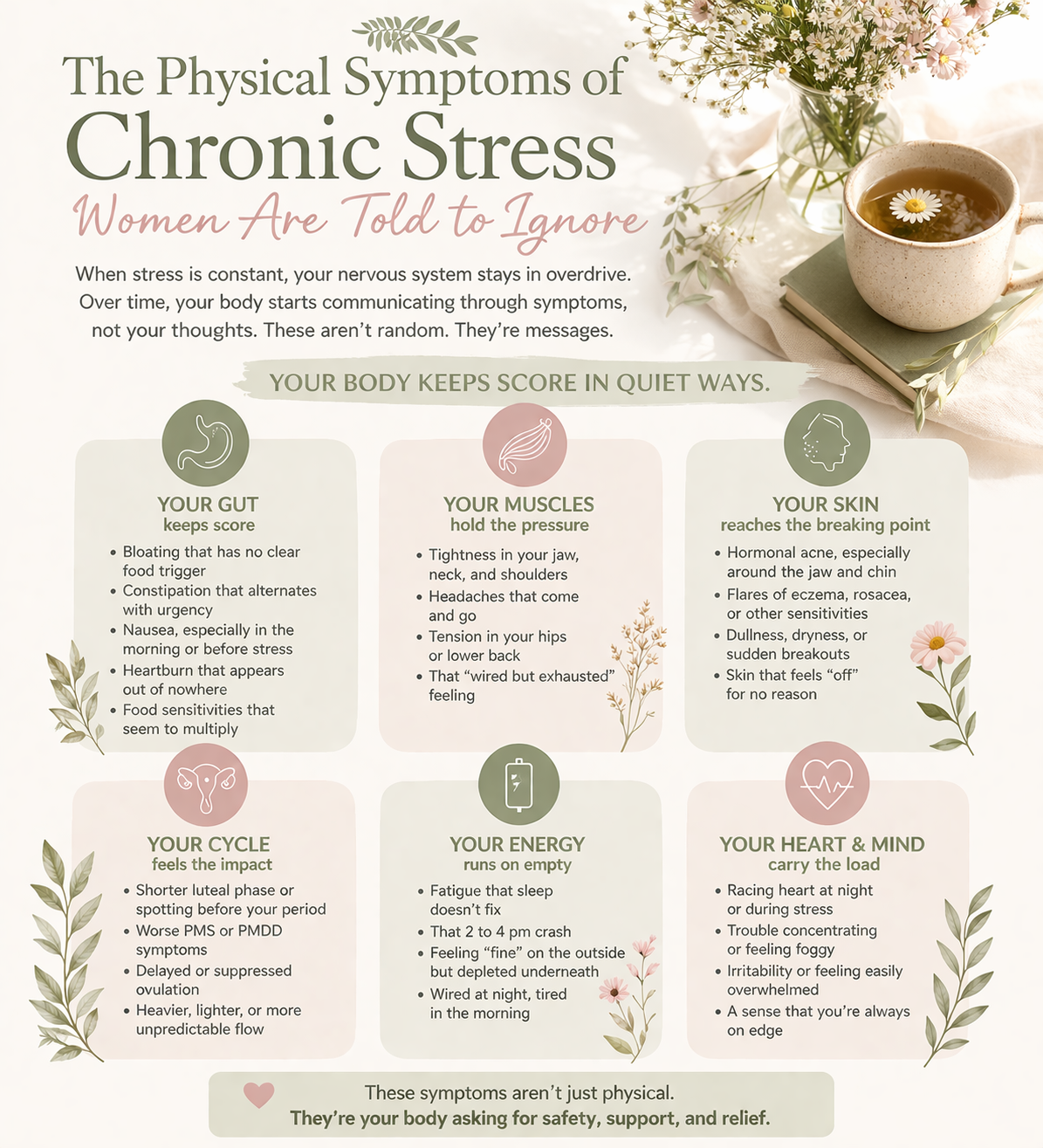
The Physical Symptoms of Chronic Stress Women Are Told to Ignore
Let us be specific, because vague lists are not helpful when you are trying to connect dots your doctor did not.
Your Gut Is Keeping Score
The gut-brain axis is a bidirectional communication highway between your central nervous system and your enteric nervous system, the nervous system that lives in your digestive tract. When your stress response is chronically activated, gut motility changes. Stomach acid production shifts. The integrity of the gut lining can be compromised over time. Beneficial bacteria are affected.
This is why so many chronically stressed women deal with:
Bloating that has no clear food trigger
Constipation that alternates with urgency
Nausea, especially in the morning or before stressful events
Food sensitivities that seem to multiply over time
Heartburn that appears out of nowhere
None of these are random. They are stress in a different format.
Your Muscles, Skin, and Cycle Are Talking Too
The hypothalamic-pituitary-adrenal axis, the HPA axis, governs your stress hormone response. When it is chronically activated, it draws resources from other systems. Specifically, it downregulates the hypothalamic-pituitary-gonadal axis, which governs your reproductive hormones.
This is why chronic stress can:
Shorten your luteal phase or cause spotting before your period
Worsen PMS and PMDD symptoms significantly
Delay ovulation or suppress it entirely under prolonged stress
Trigger hormonal acne, particularly around the jaw and chin
Contribute to hair thinning or excessive shedding
Muscle tension, skin flares, and cycle irregularities are not separate issues waiting for separate solutions. They are the body's coordinated response to a nervous system that has been in overdrive for too long.
Why You Do Not Feel Stressed (But Your Body Clearly Is)
This is the part that trips most women up.
If you asked yourself right now whether you are stressed, your honest answer might be: not really. You have a lot going on, but you are managing. You are not panicking. You are handling it.
The Adaptation Phase: When Your System Stops Signaling Clearly
Here is what happens with long-term chronic stress: the body adapts. Cortisol output, which spikes initially under stress, can actually become dysregulated over time. Some women end up with cortisol that is blunted in the morning when it should be high, and elevated at night when it should be low. Others have a flat cortisol curve that explains their complete inability to feel rested or motivated.
When cortisol dysregulation sets in, you stop feeling stressed the way you used to. You just feel flat. Or tired. Or numb. Or like everything is fine on the surface but something is fundamentally off underneath.
What High-Functioning Stress Actually Looks Like
High-functioning stress does not look like falling apart. It looks like:
Being productive but emotionally unavailable
Sleeping but never feeling rested
Eating but never feeling nourished
Moving through your day on autopilot and calling it fine
Having a body that is holding a silent alarm that your mind has learned to mute
This is not resilience. This is your nervous system in a state of sustained dysregulation that has normalized itself, and that normalization is what makes it so difficult to catch.
What Your Body Is Actually Asking For
Your body is not broken. It is not overreacting. It is asking, in the only way it knows how, for the nervous system to get what it needs.
That does not mean meditating more or taking a bubble bath. It means actually addressing the underlying load on your HPA axis. It means supporting your gut, because the gut and the stress response are not separate conversations. It means looking at your nutrition, your sleep, your mineral status, and your inflammatory load, because chronic stress depletes the very resources your body needs to regulate itself.
It also means stopping the cycle of treating symptoms in isolation while the root driver stays untouched.
The symptoms are not the problem. They are the signal.
The First Step Toward Listening
If you have been experiencing physical symptoms that do not have a clear explanation, or symptoms that keep returning no matter what you try, it is worth asking whether your nervous system is the root of what you are managing.
A good place to start is understanding how your stress response is actually showing up. The free SRI Quiz, designed to help you identify your specific score of dysregulation, so you know what you are actually working with before you try to address it.
Because the goal is not to manage your symptoms better. The goal is to give your body what it needs to stop generating them.








References & Other Relevant Articles: