

Why Do I Feel Worse Before My Period? Anxiety, Fatigue, Histamine and the Nervous System

Every month it happens. Somewhere in the week before your period arrives, you become a different version of yourself.
The anxiety that was manageable becomes overwhelming. The small things that you usually brush off feel unbearable. You are exhausted in a way that sleep does not fix. You might be crying without a clear reason. Or you feel a flatness, a numbness, or a low-grade dread that you cannot explain. Your body might feel puffy, heavy, or reactive. If you have histamine intolerance or MCAS, your symptoms may flare dramatically in this window.
And then your period starts. And within a day or two, you feel like yourself again.
This pattern is so predictable, so precise in its timing, and so physically real that it deserves a real explanation. Not a reassurance that it is normal. Not a suggestion to take ibuprofen. An actual explanation of what is happening in your body, why it happens, and what you can do to support yourself through it.
That is what this post is.
This Is Not in Your Head
Before we get into the biology, let us name something important.
The experience of feeling significantly worse in the week before your period is real, measurable, and documented in research. The research is clear: anxiety and stress are elevated more broadly throughout the luteal phase compared to the follicular phase, with the sharpest spikes in the late luteal window, the 5 to 7 days immediately before menstruation begins.
A 2025 study found that the brain's early emotional processing response is significantly larger for negative stimuli during the late luteal phase. The brain is not overreacting. It is processing negative information more intensely at a neurological level during this window. Every month. On a biological schedule.
This is not a character flaw. It is not weakness. It is not something you should just push through. It is your nervous system operating in a measurably different state, driven by a hormonal shift that affects your brain chemistry, your immune system, your histamine load, and your stress resilience all at once.
What Is the Luteal Phase?
Your menstrual cycle has four phases. The luteal phase is the second half of your cycle, beginning after ovulation and ending when your period starts. For most women this is roughly days 15 to 28 of a 28-day cycle, though the timing varies.
During the luteal phase, progesterone rises significantly after ovulation to prepare the uterine lining for a potential pregnancy. If pregnancy does not occur, both progesterone and estrogen drop sharply in the days before your period begins. This drop is what triggers menstruation. And it is also what triggers the cascade of neurological and physical changes that make so many women feel awful in this window.
The luteal phase is consistently described in research as a window of vulnerability. A 2026 study found significantly increased stress vulnerability, decreased sociability, and decreased emotional resilience during the late luteal phase compared to the ovulatory phase.
Understanding this window changes everything. It means the symptoms you are experiencing are not random. They are tied to a predictable hormonal schedule. And once you know that, you can plan around it, support your body through it, and stop blaming yourself for it.
Why Your Brain Feels Different Before Your Period
The hormonal changes of the luteal phase affect your brain directly through two primary neurotransmitters: serotonin and GABA.
Serotonin is your mood-stabilizing, calm-and-content neurotransmitter. Estrogen supports serotonin availability in the brain. When estrogen drops in the late luteal phase, serotonin availability drops with it. You feel it as low mood, emotional fragility, irritability, and that sense that everything feels harder than it should.
GABA is your primary calming neurotransmitter, your nervous system's braking mechanism. Progesterone metabolizes in the brain into a compound called allopregnanolone, which directly activates GABA receptors and produces a calming, anti-anxiety effect. When progesterone drops sharply in the late luteal phase, this natural GABA support disappears.
Research from NIH describes this as a central nervous system withdrawal effect, similar in mechanism to benzodiazepine withdrawal, which is why the late luteal phase can trigger intense anxiety, irritability, and emotional reactivity that feels disproportionate to what is actually happening in your life.
Your brain is not overreacting. It lost its natural calming support on a hormonal schedule. What you are experiencing is a real withdrawal of neurochemical buffers that were protecting your nervous system.
The Progesterone Withdrawal Nobody Talks About
This is the part most PMS conversations completely miss.
Progesterone does not just affect your uterus. It is one of the most important neurosteroids in the female brain. Through its metabolite allopregnanolone, it acts directly on GABA-A receptors to produce sedation, anxiolysis, and emotional stability. It is your body's natural anxiety buffer.
When progesterone rises in the early luteal phase, many women feel a brief window of calm. When it drops sharply in the late luteal phase, that buffer disappears. The brain experiences this as a rapid loss of inhibitory tone, meaning the braking system that kept anxiety manageable suddenly becomes much less effective.
For women who are already stressed, depleted, or in HPA axis burnout, the late luteal progesterone drop hits harder. Under prolonged stress, the body prioritizes production of cortisol for survival, which is commonly referred to as the pregnenolone steal. As cortisol demand rises, the availability of progesterone declines further. A woman already dealing with stress-driven low progesterone enters the luteal phase with less of this natural buffer to begin with. When it drops, she falls further, faster.
This is one reason why women with burnout, poor sleep, insulin resistance, or chronic inflammation often experience more severe PMS patterns. They have less progesterone resilience to begin with.
Read more: Why Am I Gaining Weight When Stressed?
Read more: Burnout and HPA Axis Fatigue





Why Histamine Spikes Before Your Period
This is the connection that most PMS articles never discuss. And for women with histamine intolerance or MCAS, it is often the key to understanding why their worst days of every month fall in this precise window.
Estrogen and histamine have a bidirectional relationship. Estrogen stimulates mast cells to release histamine. And histamine stimulates the ovaries to produce more estrogen. They amplify each other.
During the late follicular phase and early luteal phase, when estrogen peaks, histamine levels rise alongside it. This is the window when many histamine-sensitive women experience their worst symptoms: flushing, hives, headaches, racing heart, anxiety, and digestive upset.
Progesterone, when adequate, helps counterbalance this by stabilizing mast cells and supporting DAO enzyme activity, the enzyme that breaks down histamine in the digestive tract. But when progesterone is low or drops suddenly in the late luteal phase, this mast-cell-stabilizing effect diminishes. Histamine rises without its natural check.
The result is that in the week before your period, histamine-sensitive women are dealing with two simultaneous stressors: rising histamine load from declining progesterone protection, and the neurological effects of progesterone withdrawal described above. Both produce anxiety. Both produce fatigue. Both produce physical reactivity and overwhelm. Together they create a pattern that feels completely out of proportion to what is happening in daily life.
If this sounds like you, and if your worst symptoms reliably fall in the 5 to 7 days before your period, the histamine-estrogen-progesterone triangle is worth understanding and addressing.
Read more: Is Histamine Intolerance Causing Your Anxiety?
Read more: The Histamine Bucket Explained
The Nervous System Connection
Here is the part that ties everything together.
The female brain is measurably more sensitive to stress during the luteal phase. These hormonal fluctuations influence brain chemicals that regulate mood, including serotonin and GABA. When hormone levels change, the brain becomes more sensitive to stress, making everyday concerns feel bigger and harder to manage.
This is not metaphorical. It is neurological. The same situation that felt manageable during the follicular phase, when estrogen is rising and serotonin is supported, feels genuinely threatening during the late luteal phase, when those supports are withdrawn.
For women who already have a dysregulated nervous system from chronic stress, trauma, burnout, or HPA axis fatigue, the luteal phase amplifies what is already present. The nervous system that is barely regulated during the follicular phase becomes significantly less regulated in the late luteal window.
And because sleep also worsens in the late luteal phase, hormonal changes affect body temperature, cause night sweats, increase restlessness, and make it harder to fall and stay asleep, the cortisol picture is compounded further. Poor sleep raises cortisol. Elevated cortisol worsens progesterone depletion. And the cycle continues.
Read more: 12 Things That Help Calm an Overstimulated Nervous System
Read more: Why You Feel Worse After Resting
Why Burnout Makes Everything Worse in the Luteal Phase
If you are dealing with burnout or HPA axis dysregulation, the luteal phase is when your system's limits show up most visibly.
When the body is under chronic stress, cortisol production competes with progesterone production for the same hormonal precursors. The body prioritizes cortisol for survival. Progesterone gets less. The natural GABA buffer becomes smaller. And when the late luteal drop happens, there is less to lose before symptoms become severe.
Women with burnout also tend to have lower baseline serotonin availability, lower magnesium stores, impaired sleep architecture, and higher baseline inflammatory load. Every one of these factors amplifies the luteal phase experience.
This is why the luteal phase is not an isolated hormone story. It is a whole-body story. How you are sleeping, how stable your blood sugar is, how supported your nervous system is, how healthy your gut is, and how depleted or resourced your overall system is all determines how hard your luteal phase hits you.
The good news is that all of those things are addressable. Not perfectly and not immediately. But consistently, over time, the luteal phase becomes less of a crisis and more of a phase you can navigate.
What Can Support Your Body in the Week Before Your Period
Magnesium Glycinate
Magnesium directly supports GABA receptor activity, which makes it one of the most relevant supplements for the luteal phase. When progesterone is dropping and GABA support is diminishing, magnesium provides an alternative pathway for GABA support. It also reduces prostaglandin activity, which contributes to cramping, and supports better sleep quality in the luteal window when sleep is most disrupted.
Multiple studies have found that magnesium supplementation reduces PMS symptoms including mood changes, anxiety, water retention, and menstrual pain. A good starting dose is 300 to 400 mg of magnesium glycinate before bed throughout the month, with particular attention to consistent use in the 10 days before your period.
Read more: Magnesium Glycinate for Women
Vitamin B6
Vitamin B6 is essential for the production of both serotonin and GABA. When B6 is low, the production of these neurotransmitters is impaired. The luteal phase, when serotonin is already more vulnerable, is when B6 status matters most.
Research supports B6 supplementation for PMS-related mood symptoms, including anxiety, irritability, and depression. Active B6 as pyridoxal-5-phosphate is the best-absorbed form. It is often most effective when taken alongside magnesium.
Omega-3 Fatty Acids
Omega-3 fatty acids reduce systemic inflammation and support serotonin receptor sensitivity. Because the luteal phase involves an increase in prostaglandin-driven inflammation alongside the neurotransmitter changes described above, omega-3s address both dimensions simultaneously. Research supports omega-3 supplementation for reducing PMS mood symptoms and menstrual pain.
Quercetin for Histamine-Sensitive Women
If histamine is part of your luteal phase picture, quercetin taken consistently throughout the second half of your cycle can meaningfully stabilize mast cells and reduce the histamine load that amplifies anxiety, flushing, and reactivity. Take quercetin 20 to 30 minutes before meals during the luteal phase.
Protein and Blood Sugar Stability
Women tend to crave carbohydrates and sugar before their period, and that craving is real and hormonally driven. But feeding it with refined carbohydrates creates the blood sugar spike-and-crash cycle that amplifies cortisol output, worsens anxiety, and deepens fatigue. Frequent blood sugar spikes increase adrenaline and cortisol output, and the rapid crash creates shakiness, irritability, and heightened anxiety.
Protein at every meal throughout the luteal phase is one of the most practical and impactful interventions. It stabilizes blood sugar, provides the amino acid building blocks for serotonin and GABA production, and reduces the cortisol surges that exacerbate the progesterone withdrawal.
Read more: What to Eat When Your Nervous System Is Dysregulated
Sleep Support
Sleep disruption in the luteal phase is real and physiological. Supporting sleep quality during this window is one of the highest-leverage interventions available. Magnesium glycinate before bed, consistent sleep and wake times, a dark and cool room, and screens off 60 minutes before bed are the foundational steps. If histamine is disrupting sleep alongside the hormonal changes, DAO enzyme support before dinner can reduce nighttime histamine load.
Read more: Why You Are Exhausted Even After Sleeping 8 Hours
Nervous System Regulation Daily, Not Just When You Are Struggling
Because the nervous system is measurably more reactive during the late luteal phase, daily regulation practices matter more in this window than at any other point in your cycle. Extended exhale breathing, gentle morning movement, consistent meal rhythm, and adequate rest all send your nervous system the signal that it is safe, even when the hormonal environment is making it feel less so.
Building these practices throughout the month means they are already in place when the luteal window arrives, rather than trying to implement them when you are already in the thick of symptoms.
Read more: 12 Things That Help Calm an Overstimulated Nervous System
My Luteal Phase Support Stack
These are the tools and products I return to most often when supporting women through luteal phase symptoms. They are not quick fixes. They work by consistently supporting the systems that the luteal phase stresses most.
The Bottom Line
Feeling significantly worse in the week before your period is not a sign that something is wrong with you. It is a sign that your body is responding to a predictable hormonal shift that affects your brain chemistry, your nervous system reactivity, your histamine load, and your stress resilience all at once.
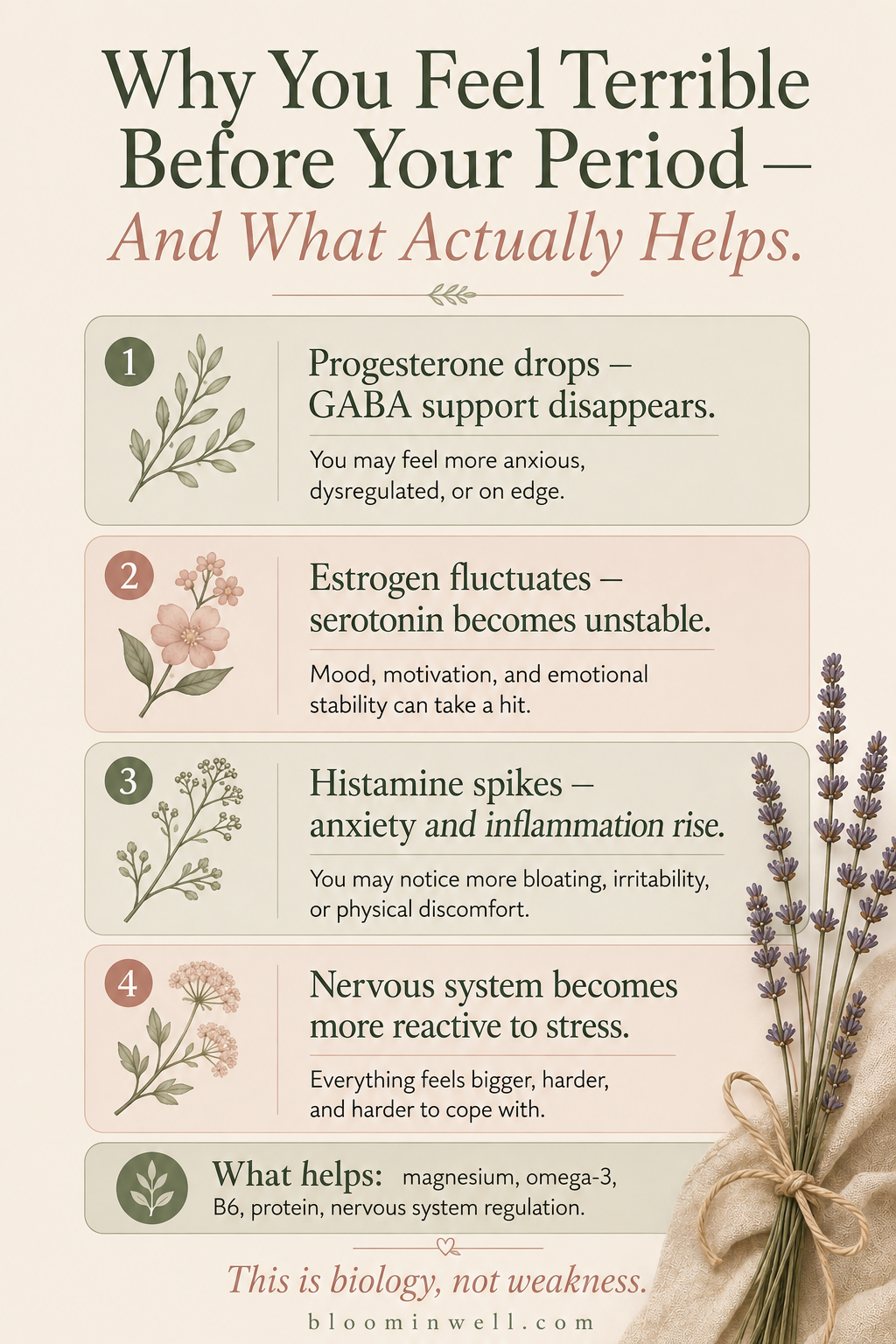
Progesterone drops and takes your natural GABA buffer with it. Serotonin becomes less stable as estrogen fluctuates. Histamine rises as progesterone's mast-cell-stabilizing effect diminishes. The nervous system becomes measurably more reactive to stress. And if you are already dealing with burnout, chronic stress, or HPA axis dysregulation, all of it is amplified.
The most effective supports work with this biology rather than against it. Magnesium for GABA support. B6 for serotonin and GABA production. Omega-3s for inflammation and mood. Quercetin for histamine-sensitive women. Protein at every meal for blood sugar and neurotransmitter building blocks. Sleep protected as a priority. And nervous system regulation practiced daily, not just when symptoms are at their worst.
You know your body. You know this pattern. Now you have the explanation that matches what you have been experiencing every month. And that is where real support begins.
Read more: Is Histamine Intolerance Causing Your Anxiety?
Read more: Magnesium Glycinate for Women
Read more: Estrogen Dominance Decoded
Sources
Soula. The Luteal Phase and Anxiety: Why You Feel Worse Before Your Period. 2026. https://soula.care/blog/stress-and-anxiety/the-luteal-phase-and-anxiety
Soula. What Happens to Your Mental Health in Each Phase of Your Menstrual Cycle. 2026. https://soula.care/blog/emotions-and-mental-health/what-happens-to-your-mental-health-in-each-phase-of-your-menstrual-cycle
iThrive Academy. Why Anxiety Gets Worse Before Your Period: The Hormone Brain Connection. https://www.ithrive.academy/blogs/why-anxiety-gets-worse-before-period
Women's Mental Health Specialist. Why Is My Anxiety Worse Before My Period? 2026. https://womensmentalhealthspecialist.com/why-is-my-anxiety-worse-before-my-period-understanding-hormonal-mood-shifts/
Dr. Jolene Brighten. Histamine and PMDD: The Hidden Link Worsening Your Symptoms. 2025. https://drbrighten.com/histamine-and-pmdd/
Dr. Becky Campbell. Histamine Intolerance Worse Before Your Period? Here's Why. https://drbeckycampbell.com/progesterone-and-histamine/
Wyatt KM, et al. Efficacy of vitamin B-6 in the treatment of premenstrual syndrome: systematic review. BMJ. 1999;318(7195):1375–1381. https://pubmed.ncbi.nlm.nih.gov/10334745/
Facchinetti F, et al. Magnesium prophylaxis of menstrual migraine: effects on intracellular magnesium. Headache. 1991;31(5):298–301. https://pubmed.ncbi.nlm.nih.gov/1860787/
Taghizadeh M, et al. The effect of omega-3 fatty acids on premenstrual syndrome. ISRN Obstetrics and Gynecology. 2011. https://www.ncbi.nlm.nih.gov/pmc/articles/PMC3235207/
Rapkin AJ, Berman SM, London ED. The Cerebellum and Premenstrual Dysphoric Disorder. AIMS Neuroscience. 2014;1(2):120–141. https://www.ncbi.nlm.nih.gov/pmc/articles/PMC4286877/