

Chinese Herbs for Endometriosis & Painful Periods: A Simple Guide to Blood Stasis, Cold, and Qi Stagnation
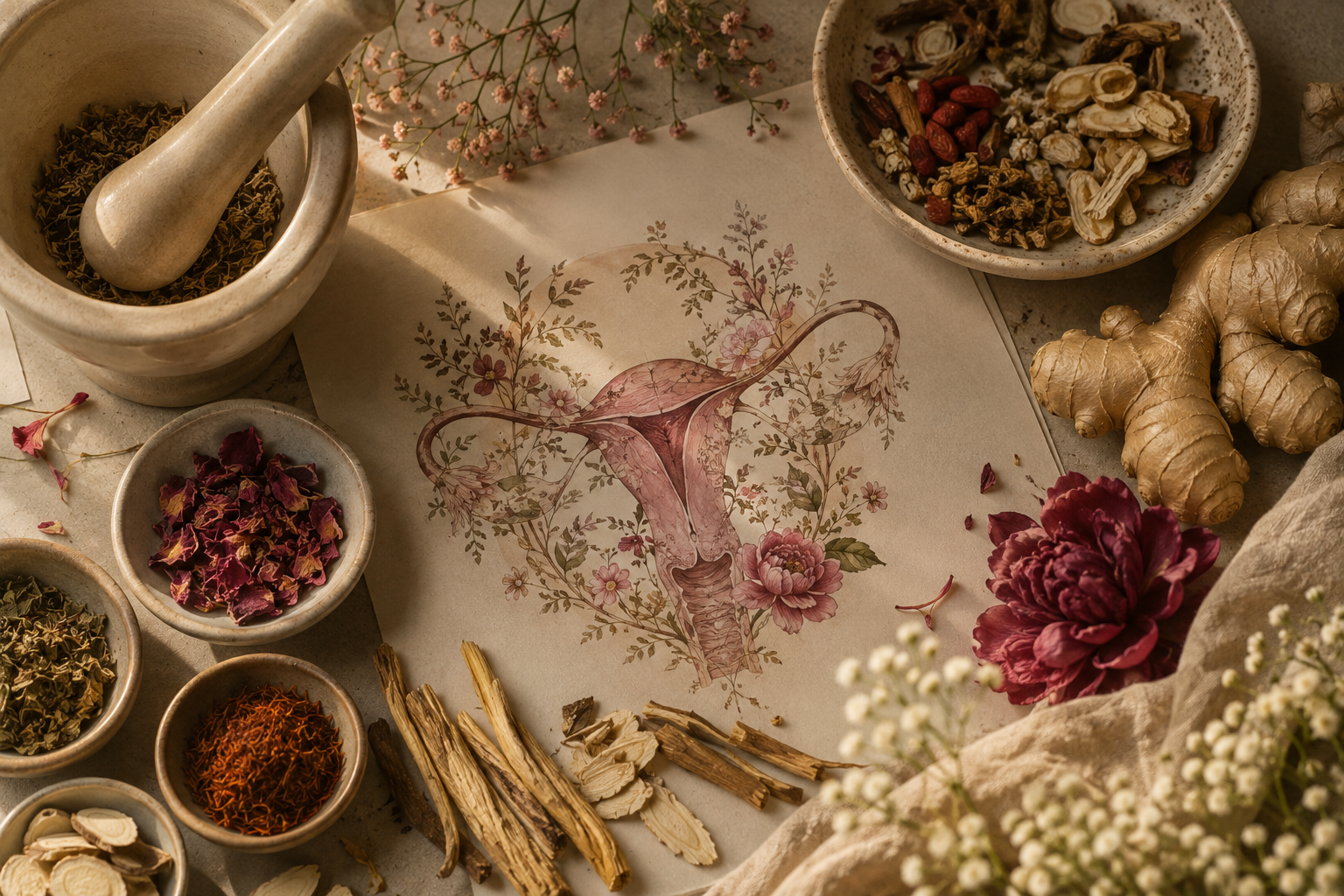
If your period doubles you over, you already know that "just take some ibuprofen" is not enough. You've heard the words "blood stasis" or "cold in the uterus" from an acupuncturist and nodded along, not totally sure what it meant. Let's fix that.
This guide breaks down what Traditional Chinese Medicine (TCM) says about endometriosis and painful periods, what the actual research shows about the herbs used for it, and how to think it through safely — in plain words, not clinic-speak.
Quick Answer
In Chinese medicine, painful periods and endometriosis are seen as a problem with blood flow — mainly "blood stasis" (blood that is stuck and not moving well), often made worse by cold, stress-related energy blockage ("qi stagnation"), or weak reserves ("kidney deficiency"). Herbal formulas built to move blood and warm the body — like Shaofu Zhuyu Tang or Guizhi Fuling Wan — have real human research behind them, including a 2025 review of over 100 clinical trials showing less pain and fewer symptoms when these herbs were added to standard care. The evidence is promising but not perfect, and these herbs are strong. They work best with a licensed herbalist who checks your pattern, your health history, and any medicines you take.
At a Glance
Chinese medicine treats period pain and endometriosis as a "stuck blood" problem, not one single disease.
Three patterns show up again and again: blood stasis, cold in the uterus, and qi (energy) stagnation.
Several herbal formulas have been tested in real human clinical trials, not just used out of tradition.
These herbs are not gentle "tea and toast" herbs. Some should never be used in pregnancy or with blood thinners.
A trained TCM practitioner should match the formula to your pattern. One formula does not fit every woman.
What Endometriosis and Painful Periods Actually Are
Endometriosis happens when tissue that acts like the lining of the uterus grows in places it shouldn't — on the ovaries, the tubes, or other spots in the belly. Every month, that tissue tries to act like a period, even though it's in the wrong place. That causes swelling, scar tissue, and pain. It affects roughly 1 in 10 women during their reproductive years.
Painful periods (doctors call this dysmenorrhea) can happen with or without endometriosis. Sometimes there's no clear cause found on a scan at all, that's called "primary" pain. Other times, something like endometriosis, fibroids, or adenomyosis is behind it, that's "secondary" pain. Either way, the pain is real, and it deserves real answers.
Why TCM Sees This as a "Stuck Blood" Problem
In Western medicine, period pain is mostly blamed on prostaglandins, chemicals that make the uterus squeeze hard, cutting off its own blood supply for a moment, which causes cramping.
In Chinese medicine, the idea is simpler to picture: pain happens where blood does not flow freely. Think of a river. When water moves, it stays clear. When it gets blocked, it backs up, gets murky, and forms clumps. TCM sees the uterus the same way. When blood moves well, periods come and go without much trouble. When blood gets "stuck," you get cramping, dark clots, and pain that doesn't ease up with heat or rest.
This idea isn't just old folklore. Modern lab studies on these formulas show they can calm inflammation, ease muscle spasm in the uterus, and improve blood flow to the pelvis — which lines up surprisingly well with the old "stuck blood" description.
The Three Main Patterns
A good TCM practitioner doesn't just say "you have endometriosis" and hand you one formula. They ask about your pain, your clots, your temperature, your stress, and your cycle, then sort you into a pattern (sometimes more than one).
Blood Stasis
What it feels like: Sharp, stabbing pain that stays in one spot. Dark, clotted blood. Pain that's worse when you press on your belly.
The TCM idea: Blood has pooled and clumped instead of flowing through smoothly.
Herbs often used: Peach kernel (Tao Ren), safflower (Hong Hua), red peony (Chi Shao), and Chinese salvia root (Dan Shen).
Cold in the Uterus
What it feels like: Cramping that eases with a heating pad or hot bath. Feeling cold in general. Pain that gets worse in winter or after cold drinks.
The TCM idea: Cold makes things tighten up and slow down — like how cold syrup pours slower than warm syrup. Cold "freezes" blood flow in the pelvis.
Herbs often used: Cinnamon twig (Gui Zhi), dried ginger (Gan Jiang), and fennel seed (Xiao Hui Xiang).
Qi Stagnation (Stress-Related Energy Blockage)
What it feels like: Cramping that comes with irritability, bloating, sore breasts, or mood swings before your period. Pain that moves around instead of staying in one spot.
The TCM idea: "Qi" is your body's energy flow, closely tied to your liver system in TCM (not the same as your liver organ in Western medicine). Stress bottles this energy up, and blood follows qi — so stuck energy leads to stuck blood.
Herbs often used: Bupleurum (Chai Hu), white peony (Bai Shao), and cyperus (Xiang Fu).
A fourth pattern, kidney deficiency, shows up too, especially in women who also deal with fatigue, low back pain, or fertility struggles. It's often treated alongside blood stasis rather than on its own.
Bloomin' Well take: Don't try to self-diagnose your pattern from a blog post — including this one. Patterns overlap, and a formula built for cold won't do much for straight-up blood stasis, and could even backfire. This is exactly the kind of thing a licensed practitioner is for.
What the Research Actually Shows
Here's where we get honest about the evidence, because Bloomin' Well isn't in the business of overselling you.
Strong-ish human evidence:
A 2025 systematic review pooling 11 randomized controlled trials (1,186 women) found that Shaofu Zhuyu Tang, a classic blood-moving formula, added to standard endometriosis care lowered pain scores and a blood marker called CA-125 more than standard care alone.
A large 2026 network meta-analysis of 107 randomized controlled trials found that blood-moving Chinese herbal formulas, combined with conventional therapy, outperformed conventional therapy by itself across several measures, including pain and cyst size.
A Cochrane review (the gold standard for evidence summaries) looked at Chinese herbal medicine for primary painful periods and found it worked better than NSAIDs like ibuprofen and the birth control pill in some trials, with few reported side effects.
A 2025 meta-analysis of 11 trials (1,401 women) found Chinese herbal medicine meaningfully reduced pain during periods and during sex related to endometriosis.
Promising but still shaky:
Most of these trials were done in China, often at a single hospital, with study designs that weren't always as tight as Western drug trials require. That doesn't mean the results are wrong — it means we shouldn't call this settled science yet.
Lab and animal research suggests these herbs calm inflammation and slow abnormal tissue growth, but that's not the same as proof in real women over many years.
What we don't know:
Long-term safety data (5+ years of use) is limited.
Head-to-head comparisons between different TCM formulas are rare, so "which formula is best" is still mostly a matter of practitioner experience, not hard data.
Cochrane's own conclusion is a fair one to borrow: the evidence looks promising, but the quality of many trials is still not where researchers want it to be. That's not a reason to write off Chinese herbs. It's a reason to use them carefully, with guidance, instead of guessing.
Herbs and Formulas, One at a Time
Shaofu Zhuyu Tang (Lower Abdomen Blood-Moving Decoction)
What it is: A classic formula built around cinnamon, dried ginger, and blood-moving herbs like myrrh and Chinese salvia.
Why it's used: It's the go-to formula for cold-type blood stasis — cramping that eases with heat.
What the evidence shows: The strongest human data of any formula in this guide. The 2025 meta-analysis above found it lowered pain scores and CA-125 levels when added to standard care.
Safety notes: Contains warming, moving herbs that are generally avoided in pregnancy and with active heavy bleeding. Not for women on blood thinners without a practitioner's sign-off.
Guizhi Fuling Wan (Cinnamon Twig and Poria Pill)
What it is: One of the oldest, most-studied formulas for "abdominal masses" from blood stasis — cinnamon twig, poria (a mushroom), peach kernel, peony, and moutan bark.
Why it's used: Traditionally for fibroids, cysts, and endometriosis-type masses tied to blood stasis, sometimes with a cold component.
What the evidence shows: Lab studies show it may calm inflammation and improve pelvic blood flow. It shows up as a "core" formula across multiple large studies and prescription databases in Taiwan and China.
Safety notes: Avoid in pregnancy. Use caution if you have heavy bleeding, are on blood thinners, or have liver or kidney concerns.
Si Wu Tang (Four Substance Soup)
What it is: A gentler, foundational formula — Chinese angelica (Dang Gui), Chinese lovage root (Chuan Xiong), white peony, and prepared rehmannia.
Why it's used: Built to nourish blood while gently moving it, often used as a base formula that other herbs get added onto.
What the evidence shows: A placebo-controlled pilot trial found it eased primary period pain more than a placebo, with good safety and compliance.
Safety notes: Generally considered milder than the formulas above, but Dang Gui and Chuan Xiong still have blood-moving effects and should be avoided in pregnancy and used cautiously with blood thinners.
Individual Blood-Moving Herbs Worth Knowing
Dan Shen (Chinese Salvia root): Shows up across many formulas for improving pelvic blood flow. Human trials in endometriosis often study it as part of a formula rather than alone.
Yi Mu Cao (Chinese Motherwort): A traditional go-to for regulating periods and easing cramps. Long history of traditional use; less standalone clinical trial data.
San Leng and E Zhu (Sparganium and Curcuma): Stronger blood-breaking herbs traditionally reserved for masses and stubborn stasis. These are potent — not something to self-prescribe.
Bloomin' Well take: None of these herbs are "one and done" fixes taken alone. In real TCM practice, they're combined into formulas matched to your pattern, dose, and health history. Buying a random bag of Dan Shen off the internet is not the same as working with a formula built for you.
Warming Herbs for a Cold Pattern
If heat helps your cramps and cold makes them worse, a cold pattern may be part of your picture. On top of formulas like Shaofu Zhuyu Tang, TCM also uses herbal foot baths — soaking your feet and lower legs in a warm herbal soak for 20 to 30 minutes — as an add-on therapy.
A 2023 review of 18 randomized trials (nearly 1,500 women) found herbal foot baths, used alongside other care, reduced period pain scores. It's a low-risk, low-cost option worth asking your practitioner about, especially if needles or oral herbs aren't your thing.
Common warming herbs in these baths and formulas include cinnamon twig (Gui Zhi), dried ginger (Gan Jiang), and fennel seed (Xiao Hui Xiang) — all of which show up traditionally, and in some lab research, as agents that improve local blood flow.
Herbal Tea: What It Can and Can't Do
A warm cup of ginger or cinnamon tea during your period is a genuinely nice, low-risk comfort habit. Ginger in particular has decent human research behind it for period pain on its own, working through similar anti-inflammatory pathways as NSAIDs.
But here's the honest part: tea is weak medicine. A formula like Shaofu Zhuyu Tang, when studied, is cooked down (decocted) from raw herbs at doses far higher than a tea bag delivers. If your pain is mild and manageable, a warming tea habit is a lovely daily ritual. If your pain sends you to bed or off work, tea alone is not going to do the job a real formula or a doctor's visit can do.
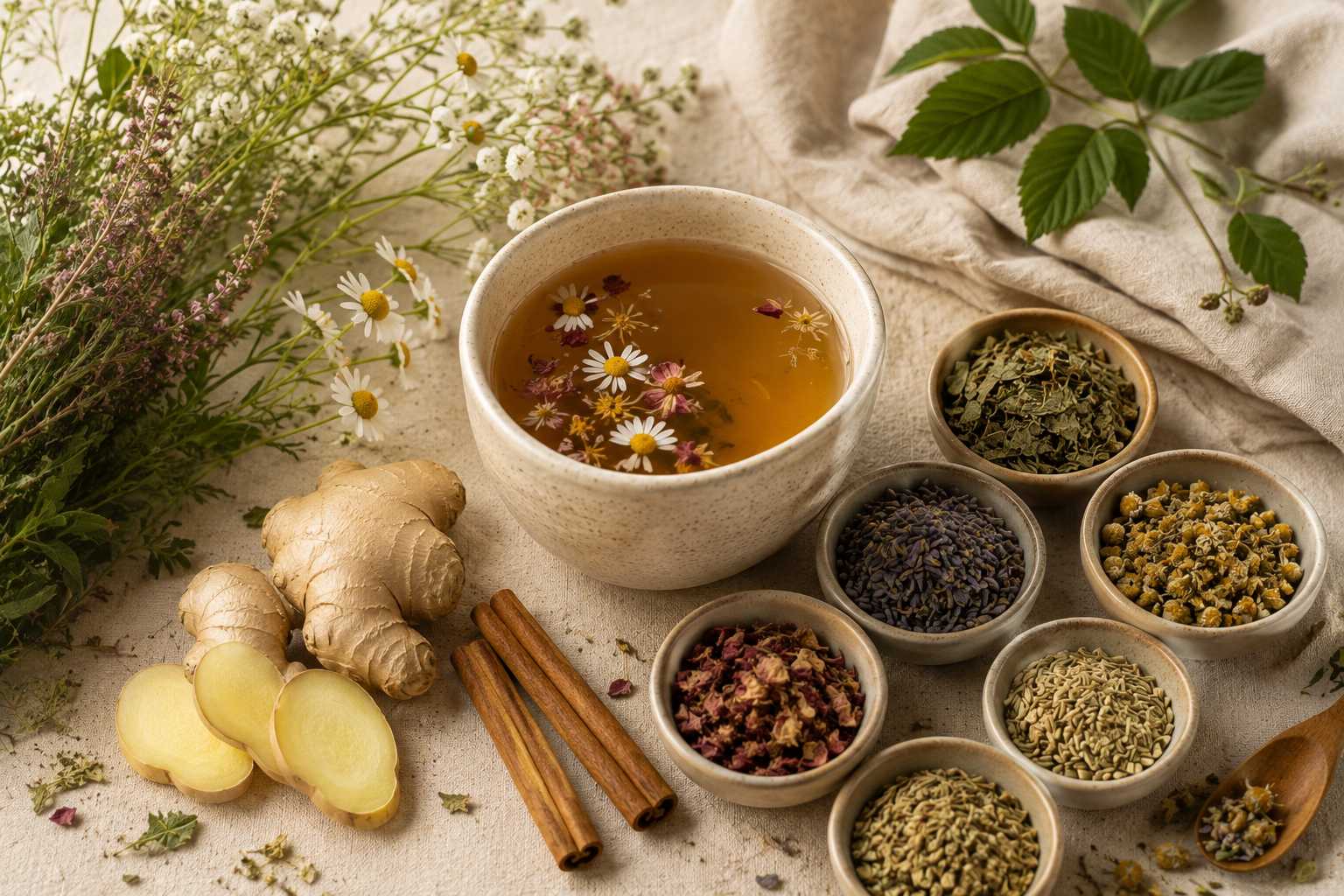
Simple Cramp-Ease Tea: Fresh ginger slices, a small cinnamon stick, and a spoonful of raw honey, steeped 10 minutes in hot water. Best sipped starting a day or two before your period and through the first heavy day.
What to Look for Before You Buy Anything
If you're looking at Chinese herbal formulas online or in a shop, here's what actually matters:
Third-party testing. Chinese herbal products have had real, documented problems with heavy metals and contamination in the past. Look for brands that test every batch for heavy metals and pesticides, not just "quality controlled" marketing language.
A named, sourced formula — not a mystery blend. You want to see every herb listed by both its Chinese and Latin name, not "proprietary blend."
Practitioner-grade sourcing. Reputable Chinese medicine dispensaries and practitioner-only supplement lines tend to have tighter sourcing standards than random online herb shops.
Raw herbs vs. pills vs. granules. Raw herbs cooked into a tea (decoction) are traditionally considered the strongest and most adjustable. Pressed pills and granules are more convenient but usually gentler.
A real practitioner behind the recommendation. The single best "quality control" step is having a licensed acupuncturist or Chinese herbalist choose and monitor your formula, rather than picking one off a shelf.


Safety First
These are not "can't hurt to try" herbs. Please read this section, even if you skipped everything else.
Pregnancy and breastfeeding: Most blood-moving formulas in this guide are not safe in pregnancy. Some are specifically used to bring on a period and should never be taken if pregnancy is possible.
Blood thinners: Herbs like Dan Shen, Dang Gui, and Chuan Xiong can add to the effect of blood-thinning medicines, raising bleeding risk. Tell your practitioner about every medicine and supplement you take.
Heavy or abnormal bleeding: If your bleeding is already heavy, some blood-moving herbs can make it heavier. This needs a practitioner's eyes on it, not guesswork.
Upcoming surgery: Blood-moving herbs are usually stopped one to two weeks before any planned surgery.
Liver or kidney conditions: Some formulas are processed through the liver and kidneys and need dose adjustments or should be avoided.
New or worsening pain: Sudden, severe pelvic pain, fever, fainting, or pain that's new and different from your usual pattern needs a same-day call to your doctor — not a trip to the herb shelf. Chinese herbs support ongoing care; they do not replace an evaluation for something that could be an emergency, like a ruptured cyst.
None of this is meant to scare you off Chinese herbs. It's meant to make the point that "natural" and "gentle" are not the same word. These formulas earned their reputation because they're active — which is exactly why they need to be matched to you by someone trained to do it.
Not Sure Where to Start?
If you've read this far and you're thinking, "okay, but which pattern am I?" — that's a completely normal place to land. Blood stasis, cold, and qi stagnation overlap constantly, and the wrong formula can waste your time or your money, or even work against you.
That's exactly what an Educational Consultation with Bloomin' Well is for. We'll walk through your symptoms, your cycle, your history, and help you understand which patterns fit and what questions to bring to a licensed herbalist or acupuncturist near you. This isn't a diagnosis or a prescription — it's a clear-headed starting point so you're not guessing alone.
Request an Educational Consultation →
FAQ
Can Chinese herbs get rid of endometriosis completely? No herb removes endometrial tissue that's already grown outside the uterus. Research suggests these formulas may ease pain and some markers of the condition, often best used alongside conventional care, not as a stand-alone fix.
Is it safe to take Chinese herbs with birth control or hormone therapy? Some formulas may be used alongside hormonal treatment, and research trials often studied them exactly that way. Always tell every provider you see about everything you're taking so nothing gets missed.
How long does it take to notice a difference? Most clinical trials measured results over three to six menstrual cycles, not overnight. A single cycle usually isn't enough to judge whether a formula is working.
What's the difference between raw herbs and Chinese "patent" pills? Raw herbs, cooked into a tea, are traditionally the strongest and most customizable to your pattern. Patent pills (pre-made, standardized formulas) are more convenient and consistent, but usually milder and less individualized.
Can I just buy a formula online without seeing a practitioner? You can, but it's not the safest route. Because these herbs are matched to specific patterns and interact with medicines, working with a licensed practitioner lowers your risk and raises your odds of it actually being the right formula for you.
Do I need acupuncture too, or just the herbs? They're not the same thing, but research suggests they work well together. Many of the strongest results in TCM research came from herbs and acupuncture used as a combined approach, not herbs alone.
Is cold really connected to period pain, or is that just folklore? It's an old idea, but it's not baseless. Cold causes blood vessels to narrow, which can reduce blood flow — and reduced pelvic blood flow lines up with more cramping in several studies, giving the old "cold uterus" idea a plausible modern explanation.
References
Zhao, C. et al. "Blood-invigorating Chinese herbal medicines plus conventional therapy for endometriosis: a network meta-analysis of 107 randomized controlled trials." Frontiers in Medicine, 2026.
Kim, S.B. et al. "Shaofu Zhuyu Decoction for Treating Endometriosis: A Systematic Review and Meta-Analysis." Pharmaceuticals, 2025;18(9):1296.
"Efficacy and safety of traditional Chinese medicine for endometriosis-related pain: a meta-analysis." PMC, 2025.
Wang, X. et al. "Traditional Chinese medicine prescription Guizhi Fuling Pills in the treatment of endometriosis." International Journal of Medical Sciences, 2021;18(11):2401-2408.
Zhu, X., Proctor, M., Bensoussan, A., Wu, E., Smith, C.A. "Chinese herbal medicine for primary dysmenorrhoea." Cochrane Database of Systematic Reviews, 2008, Issue 2.
"A Randomised Placebo-Controlled Trial of a Traditional Chinese Herbal Formula (Si Wu Tang) in the Treatment of Primary Dysmenorrhoea." PMC, 2007.
"Effectiveness and safety of Chinese herbal footbaths as an adjuvant therapy for dysmenorrhea: a systematic review and meta-analysis." PMC, 2023.
Burks-Wicks, C. et al. "A Western Primer of Chinese Herbal Therapy in Endometriosis and Infertility." Journal of Fertility Counselling, 2005.
Tsai, P.J. et al. "Identifying Chinese Herbal Medicine Network for Endometriosis: Implications from a Population-Based Database in Taiwan." PMC, 2017.
"Efficacy and Safety of Chinese Herbal Medicine for Endometriosis Associated Pain." American Journal of Chinese Medicine, 2022;50(4):1095-1111.
How We Researched This Guide: This article was developed using current human clinical research, systematic reviews and meta-analyses, and established Chinese herbal medicine references. Evidence was weighed by strength, sample size, and study quality — and preliminary findings were labeled as such, not oversold.
This article is for education, not diagnosis or treatment. Talk with a licensed healthcare provider and a qualified Chinese herbal medicine practitioner before starting any herbal formula, especially if you are pregnant, breastfeeding, on blood thinners or hormonal medication, or have a bleeding disorder, liver, or kidney condition.