


You are in your late 30s or 40s. You are exhausted in a way that sleep does not fix. You are anxious in a way that does not match your circumstances. Your brain feels foggy. Your sleep is broken. Your weight is shifting in ways that feel new and unfamiliar, particularly around your middle. You are irritable in a way that surprises you. And some months your period is fine, and other months it is not.
Is this burnout? Is this perimenopause? Is it both? And does the answer even matter if you feel this bad either way?
The answer does matter, because while the symptoms overlap almost completely, what drives them is different, and so is what helps most. This post helps you figure out where you actually are, what the research says about both, and what supports your body through either one.
Why This Question Is So Hard to Answer
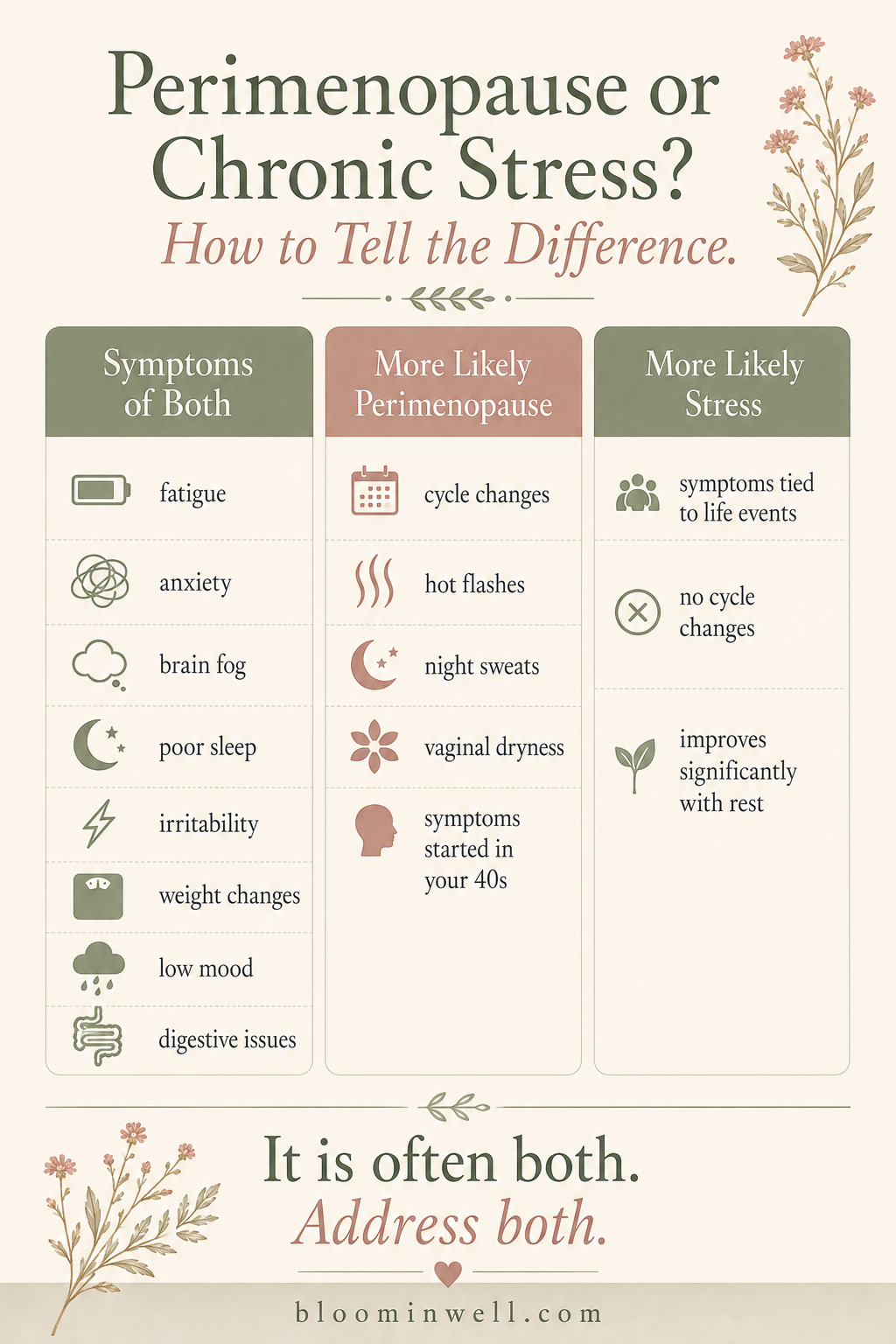
The honest reason this question is so difficult is that chronic stress and perimenopause produce many of the same symptoms through different biological mechanisms. Both disrupt cortisol rhythms. Both impair sleep architecture. Both affect serotonin and GABA. Both shift fat storage toward the abdomen. Both drive anxiety, brain fog, and fatigue.
Same output. Different cause. And often, happening simultaneously.
A January 2026 study published in Menopause, the journal of The Menopause Society, surveyed over 17,000 women across 158 countries and found that among women over 35 actually in perimenopause, the most common symptoms were fatigue, physical and mental exhaustion, irritability, depressive mood, sleep problems, digestive issues, and anxiety. Not hot flashes. Not night sweats. Fatigue, exhaustion, anxiety, and brain fog.
These are also the symptoms most commonly attributed to chronic stress, burnout, and HPA axis dysregulation. Which means that right now, there are a significant number of women in perimenopause who are being told they are simply too stressed. And there are women in burnout who are being told they must be in perimenopause. And there are women in both, navigating a compounded hormonal and physiological reality that conventional medicine is not particularly good at holding.
What the Research Says About Perimenopause Symptoms
Most women expect perimenopause to announce itself with hot flashes and night sweats. The research tells a more complicated story.
A 2026 global study covering more than 12,000 participants over age 35 found that the most commonly reported perimenopause symptoms were fatigue at 83%, exhaustion at 83%, irritability at 80%, low mood at 77%, sleep problems at 76%, digestive issues at 76%, and anxiety at 75%. Hot flashes were associated with perimenopause by 71% of women when asked what they expected, but for women actually in perimenopause, exhaustion and fatigue were reported at rates of 95% and 93% respectively, far higher than hot flash rates.
The same research found symptoms starting earlier than most people assume. Among women ages 30 to 35, more than half reported moderate to severe symptoms on a standardized menopause rating scale. Among women ages 36 to 40, that figure rose further.
A 2024 study from Newson Health surveying 978 perimenopausal women found that the five most prevalent symptoms were feeling tired or lacking energy at 96%, memory problems at 93%, difficulty concentrating, anxiety, and low mood. These are symptoms that in most clinical settings get attributed to depression, anxiety disorder, burnout, or stress before perimenopause is even considered.
This is a significant problem. Women are often prescribed antidepressants and anxiolytics for symptoms rooted in hormone deficiency, when hormone support may be far more appropriate and effective.
The 15 Symptoms That Overlap Almost Completely
These symptoms appear in both chronic stress and perimenopause. Experiencing them does not tell you which one you are dealing with. They are starting points for investigation, not diagnosis.
1. Fatigue that sleep does not fix.
Both perimenopause and chronic stress disrupt sleep architecture and HPA axis function, producing a tiredness that accumulates regardless of hours spent in bed.
2. Anxiety that feels new or disproportionate.
Declining estrogen reduces serotonin support. Chronic stress depletes GABA and raises cortisol. Both routes lead to increased anxiety, often described as a background hum of dread or a wired, on-edge feeling that was not present before.
3. Brain fog.
Poor sleep, cortisol dysregulation, and declining estrogen all impair cognitive function. Memory problems, word-finding difficulties, difficulty concentrating, and a general sense of mental slowness are reported by women in both states at nearly identical rates.
4. Poor sleep or waking through the night.
Cortisol dysregulation from chronic stress disrupts sleep architecture. Declining estrogen and progesterone in perimenopause do the same. The result is waking at 2 to 4am, light fragmented sleep, and waking unrefreshed regardless of the cause.
5. Irritability.
Disproportionate irritability, a shorter fuse than usual, and emotional reactivity that surprises even the woman experiencing it are characteristic of both HPA axis dysregulation and the estrogen fluctuations of perimenopause.
6. Low mood.
Both declining estrogen and elevated chronic cortisol reduce serotonin availability in the brain. Low mood, flatness, emotional numbness, and loss of pleasure in previously enjoyed activities appear in both.
7. Weight gain around the middle.
Cortisol drives abdominal fat storage. Declining estrogen shifts fat distribution toward the abdomen. Both produce the same change in body composition and both are resistant to conventional diet and exercise approaches if the hormonal root is not addressed.
8. Digestive issues.
The gut-brain axis means that both chronic stress and hormonal fluctuation affect digestion. Bloating, changes in bowel habits, and new food sensitivities appear commonly in both states.
9. Heart palpitations.
Stress-driven adrenaline spikes and the vasomotor instability of perimenopause both produce heart palpitations. Women often present to cardiologists or emergency rooms with this symptom before a hormonal cause is considered.
10. Joint aches and muscle pain.
Chronic cortisol elevation is catabolic and pro-inflammatory. Declining estrogen removes an anti-inflammatory protective effect. Both produce aching, stiffness, and a body that feels older than it should.
11. Hair and skin changes.
Cortisol diverts resources away from non-essential functions including hair growth and skin maintenance. Declining estrogen reduces collagen production and skin moisture. Both produce the same changes.
12. Low libido.
Chronic stress suppresses sex hormone production. Declining estrogen and testosterone in perimenopause do the same. Low libido is common in both and often unaddressed in clinical settings.
13. Temperature sensitivity.
Women in chronic stress often feel cold and cannot warm up due to thyroid and metabolic slowdown. Women in perimenopause can experience both hot flashes and cold sensitivity depending on their hormonal pattern.
14. Difficulty recovering from exercise.
Both chronic cortisol elevation and declining estrogen impair muscle recovery. Women often notice that workouts they used to handle easily now floor them for days.
15. A general sense that something has shifted.
This one is harder to quantify but consistently reported. A feeling that you are not quite yourself. That your resilience has changed. That your body has crossed some kind of invisible threshold. This subjective experience is one of the most common early reports in both burnout and perimenopause.






















The Symptoms That Help Tell Them Apart
While the overlap is significant, some symptoms are more specifically associated with one or the other.
More likely to be perimenopause if:
Your menstrual cycle has changed in pattern. Cycles becoming shorter is often the earliest perimenopausal change, sometimes years before anything else. Then cycles become irregular, 24 days, then 35, then 21. Flow changes, heavier or lighter than your normal. If your cycle has genuinely changed pattern over the last year or two and you are in your 40s, that points strongly toward perimenopause.
You experience true hot flashes or night sweats. These are the symptoms that sustained stress does not produce. A sudden wave of heat moving through the body, often with sweating, flushing, and heart rate increase, is vasomotor in origin and associated with hormonal fluctuation. Night sweats that soak the sheets are the same mechanism occurring during sleep.
You have vaginal dryness or discomfort with sex. Declining estrogen directly affects vaginal tissue. Chronic stress alone does not produce this symptom.
Your symptoms are present regardless of your stress level. Perimenopause symptoms tend to persist even during relatively calm periods. Stress-related symptoms usually have some correlation with life events and improve meaningfully with sustained rest or stress reduction.
More likely to be chronic stress or burnout if:
Your cycle is completely regular and unchanged. A regular, predictable cycle with no changes in timing or flow suggests your ovarian function is still operating normally, making perimenopause a less likely primary driver.
Your symptoms began or significantly worsened during a specific high-stress period. If you can trace the onset of your symptoms to a job change, a relationship breakdown, a loss, or another identifiable stressor, burnout or HPA axis dysregulation is more likely to be the primary driver.
You notice meaningful improvement during low-stress periods. Burnout and HPA axis dysregulation are responsive to rest, nervous system regulation, and stress reduction. Perimenopause symptoms are less responsive to these interventions alone.
Why It Is Usually Both
Here is the part that the either-or framing misses entirely.
Stress and perimenopause are not an either-or situation. Rather than thinking of it as a which came first scenario, it is more helpful to classify stress and symptoms of perimenopause as part of a feedback loop. Stress can worsen symptoms, and those symptoms can in turn increase stress.
Cortisol competes with progesterone for the same hormonal precursors. When the body prioritizes cortisol production under chronic stress, progesterone declines. Declining progesterone in perimenopause further reduces the natural GABA buffer that protects the nervous system from stress reactivity. Lower GABA buffer means more cortisol reactivity. More cortisol means more progesterone suppression. The loop tightens.
Perimenopause is like an accentuated experience of PMS. There are erratic fluctuations of hormones, big peaks of estrogen or progesterone and then a sudden drop. The result can be irregular periods, but that is not all. These hormonal fluctuations are stressful to the body. And a body already under chronic stress has less resilience to manage that additional hormonal volatility.
This is why the most exhausted, most anxious, most depleted women in this age group are often dealing with both simultaneously. They are not choosing between two explanations. They are living inside a compounded physiological reality that requires attention on both fronts.


The Feedback Loop: How Stress and Perimenopause Amplify Each Other
Understanding this loop changes what you do about it.
When chronic stress is present alongside the hormonal shifts of perimenopause, the cortisol rhythm becomes further disrupted. Sleep becomes harder to protect. Blood sugar stability becomes harder to maintain. The HPA axis, already dysregulated by years of stress, has less capacity to buffer the additional hormonal volatility of the perimenopausal transition. And the nervous system, already sensitized, becomes more reactive to each hormonal shift.
This is not a reason to feel hopeless. It is a reason to address both sides of the equation rather than choosing between them. Supporting your nervous system reduces the cortisol burden that is suppressing progesterone. Supporting hormonal balance reduces the vasomotor and mood instability that is dysregulating your nervous system. Supporting sleep improves both. Supporting blood sugar stability improves both. And getting accurate information about where you actually are hormonally, through appropriate testing, gives you the clarity to make better decisions about support.
Read more: Why You Feel Worse Before Your Period
Read more: Why Am I Gaining Weight When Stressed?
Read more: Burnout and HPA Axis Fatigue
What Supports Your Body Through Either
The good news is that much of what supports a dysregulated nervous system also supports a body navigating perimenopause. And much of what supports hormonal health in perimenopause also supports nervous system regulation. The overlap in support mirrors the overlap in symptoms.
Magnesium Glycinate
Supports GABA receptor activity, sleep architecture, cortisol regulation, and progesterone metabolism simultaneously. One of the highest-leverage supplements for women at this intersection. 300 to 400 mg of elemental magnesium glycinate before bed.
Read more: Magnesium Glycinate for Women
Omega-3 Fatty Acids
Reduce systemic inflammation, support serotonin receptor sensitivity, and help moderate the cortisol response. Research supports omega-3 supplementation for perimenopausal mood symptoms and for stress-related inflammatory load.
Protein at Every Meal
Provides the amino acid building blocks for serotonin, dopamine, and GABA. Stabilizes blood sugar, which stabilizes cortisol. Supports muscle preservation as estrogen declines and cortisol rises. This is not optional. It is foundational.
Read more: Why High Protein Calms Anxiety
Strength Training Two to Three Times per Week
Resistance exercise is one of the most well-supported interventions for both perimenopausal symptoms and HPA axis dysregulation. It improves insulin sensitivity, preserves muscle mass, reduces cortisol reactivity over time, and supports bone density. It does not need to be intense. Consistent and progressive is what matters.
Sleep as a Non-Negotiable
Both perimenopause and chronic stress disrupt sleep. Both are significantly worsened by poor sleep. Protecting sleep is therefore the highest-leverage intervention available for either state. Magnesium glycinate before bed, consistent wake times, a dark and cool room, no screens in the 60 minutes before bed, and a small protein and fat snack if blood sugar instability is waking you at 3am.
Read more: Why You Are Exhausted Even After Sleeping 8 Hours
Creatine Monohydrate
Particularly relevant for women in perimenopause. Supports muscle preservation, brain energy, mood, and reaction time. The 2026 CONCRET-MENOPA trial confirmed safety and cognitive and mood benefits specifically in perimenopausal and menopausal women. 3 to 5 grams daily.
Read more: Creatine for Women Over 30
Getting the Right Tests
If you are in your late 30s or 40s and experiencing this symptom cluster, ask your doctor for a hormone panel including FSH, LH, estradiol, progesterone, testosterone, and SHBG. Ask for a full thyroid panel including TSH, free T3, free T4, and antibodies, because thyroid dysfunction produces a nearly identical symptom cluster and is extremely common in this age group. Ask for ferritin, vitamin D, and a complete metabolic panel.
This is not about getting a diagnosis from a blood test. Perimenopause is a clinical diagnosis based on symptoms and age, not a single lab value. It is about getting enough information to make informed decisions about your support.
Read more: How to Read Your Own Labs
The Bottom Line
Perimenopause and chronic stress produce an almost identical symptom picture through different biological routes. Fatigue, anxiety, brain fog, poor sleep, irritability, weight changes, low mood, and digestive issues appear in both at nearly the same frequency. The symptoms that most clearly distinguish them are changes in your menstrual cycle, true hot flashes and night sweats, and vaginal dryness, which are perimenopause-specific, versus symptoms that clearly correlate with life stressors and improve meaningfully with rest, which point more toward burnout.
But the more important truth is that for most women in their 40s navigating this symptom cluster, it is not one or the other. It is both, operating in a feedback loop that amplifies each through the other.
The most useful response is not to choose between two explanations. It is to support both simultaneously. Nervous system regulation reduces the cortisol burden that worsens hormonal volatility. Hormonal awareness and support reduce the symptoms that dysregulate the nervous system. Sleep, protein, magnesium, movement, and accurate information about where you are hormonally are the tools that serve you in either case.
You are not falling apart. You are navigating one of the most physiologically complex transitions of your life with very little cultural or clinical support. You deserve better information than you have probably been given. And you deserve a practitioner who takes both sides of this picture seriously.
Read more: Perimenopause and the Nervous System
Read more: Why You Feel Worse Before Your Period
Read more: Creatine for Women Over 30
Sources
Lindsey Cassidy MD. Perimenopause Misdiagnosed as Stress. August 2026. https://www.lindseycassidymd.com/blog/perimenopause-symptoms-dismissed-stress-denver
Mayo Clinic News Network. Global study identifies gap between expectations and experience in perimenopause. February 2026. https://newsnetwork.mayoclinic.org/discussion/global-study-identifies-gap-between-expectations-experience-in-perimenopause/
Reisel D, Crockett C, Glynne S, Kamal A, Newson L. Prevalence of Cognitive and Mood-Related Symptoms in a Large Cohort of Perimenopausal and Menopausal Women. BJPsych Open. 2024. https://www.ncbi.nlm.nih.gov/pmc/articles/PMC11738833/
Tentis D. Perimenopause or Stress? How to Tell the Difference. August 2026. https://www.deboratentis.com/blogs/debora-tentis/perimenopause-or-stress-how-to-tell
Hers Health. Can Stress Cause Early Menopause? December 2025. https://www.forhers.com/blog/can-stress-cause-early-menopause
Bonafide Health. Can Stress Cause Early Menopause? https://hellobonafide.com/blogs/news/can-stress-cause-early-menopause
Liu X, et al. Investigation of the quality of life and influencing factors among perimenopausal women. Archives of Gynecology and Obstetrics. 2025. https://www.ncbi.nlm.nih.gov/pmc/articles/PMC12414071/
Wegrzynowicz AN, et al. Insights into perimenopause: A survey of perceptions, opinions on treatment, and potential approaches. PMC. 2025. https://pmc.ncbi.nlm.nih.gov/articles/PMC12014197/
Soula. What Happens to Your Mental Health in Each Phase of Your Menstrual Cycle. 2026. https://soula.care/blog/emotions-and-mental-health/what-happens-to-your-mental-health-in-each-phase-of-your-menstrual-cycle
Stojkov NJ, et al. Creatine in women's health: bridging the gap from menstruation through pregnancy to menopause. JISSN. 2025. https://www.tandfonline.com/doi/full/10.1080/15502783.2025.2502094