

Lemon Balm for Anxiety and Burnout: The Gentle Herb Your Nervous System Has Been Asking For

You've probably tried things that were supposed to help, supplements, protocols, maybe even a stronger adaptogen or two. And maybe some of them helped a little. But you still feel like you're running on fumes. Still anxious. Still overstimulated. Still not okay.
What if the answer isn't something stronger? What if your nervous system doesn't need a push, it needs a pause?
That's exactly what lemon balm offers. And it's been doing it for over two thousand years.
When Everything Feels Like Too Much, Your Nervous System Needs Calm, Not a Kick
There's a pattern that shows up in so many burned-out women: everything is just a little too loud. Too bright. Too much. Emails feel overwhelming. Social plans feel exhausting before they even begin. You snap at people you love and then feel terrible about it. Your body is tired but your mind won't stop.
This is nervous system dysregulation. And it's incredibly common in women who have been running on stress hormones for too long.
The instinct is to reach for something energizing, to push through, to supplement your way to more. But that's often the worst thing you can do at this stage. What your nervous system actually needs is something that helps it come down. Something that quiets the noise without wiping you out.
That's where lemon balm comes in.
What Lemon Balm Actually Is (And Why Herbalists Have Used It for Centuries)
Lemon balm (Melissa officinalis) is a perennial herb in the mint family, native to the Mediterranean. It has a gentle lemony scent and small white flowers that attract bees, which is where its botanical name comes from. Melissa is Greek for honey bee.
Herbalists have used it for over two thousand years. A sixteenth-century recommendation described lemon balm as the herb for all complaints arising from a disordered nervous system. That description still holds up remarkably well today.
It is classified as a nervine, which is an herb that directly nourishes and calms the nervous system. Unlike adaptogens, which modulate your stress response over time, nervines work more directly and often more quickly. They meet you where you are.
What Lemon Balm Does in Your Body and Brain
Your nervous system relies on a neurotransmitter called GABA (gamma-aminobutyric acid) to put the brakes on overexcitement. GABA is your brain's calm-down signal. It tells overactive neurons to settle. When GABA is low or not working efficiently, you feel anxious, restless, wired, and on edge, even when there's no clear reason to be.
Lemon balm works by inhibiting an enzyme called GABA transaminase, the enzyme responsible for breaking GABA down. When that enzyme is blocked, GABA sticks around longer in the brain. Your nervous system has more of what it needs to feel safe and settled.
Research also shows lemon balm interacts with serotonin pathways, supports healthy sleep quality, and may help reduce heart palpitations, a physical symptom that shows up frequently in women with anxiety and nervous system dysregulation.
The key compound responsible for much of this is rosmarinic acid, a powerful antioxidant found in lemon balm that crosses into the brain and gets to work relatively quickly. Some women notice a shift within the same day they begin using it.
Who Benefits Most From Lemon Balm, Especially If You're Highly Sensitive or Burned Out
Lemon balm is one of the most universally gentle herbs in the nervine category. But there are certain women it serves especially well.
You might be a great candidate for lemon balm if you:
Feel anxious or on edge without a clear reason
Struggle with racing thoughts, especially at night
Experience heart palpitations or a fluttery, restless feeling in your chest
Are highly sensitive and react strongly to stress, noise, or stimulation
Have tried stronger adaptogens and felt worse, not better
Are in the exhausted-but-wired phase of burnout
Have digestive upset that worsens under stress, lemon balm has a particular affinity for the gut-nervous system connection
Are in a period of deep depletion and need something safe enough for daily, long-term use
One of lemon balm's most important qualities for burned-out women is that it can be used during the day without causing drowsiness. It calms without sedating. It takes the edge off without taking you offline. which makes it uniquely practical for women who need to function while they heal.
How to Use Lemon Balm: Tea, Tincture, or Capsule
One of the best things about lemon balm is how accessible and forgiving it is. There's no single right way to take it — the best form is the one you'll actually use consistently.
As a Tea
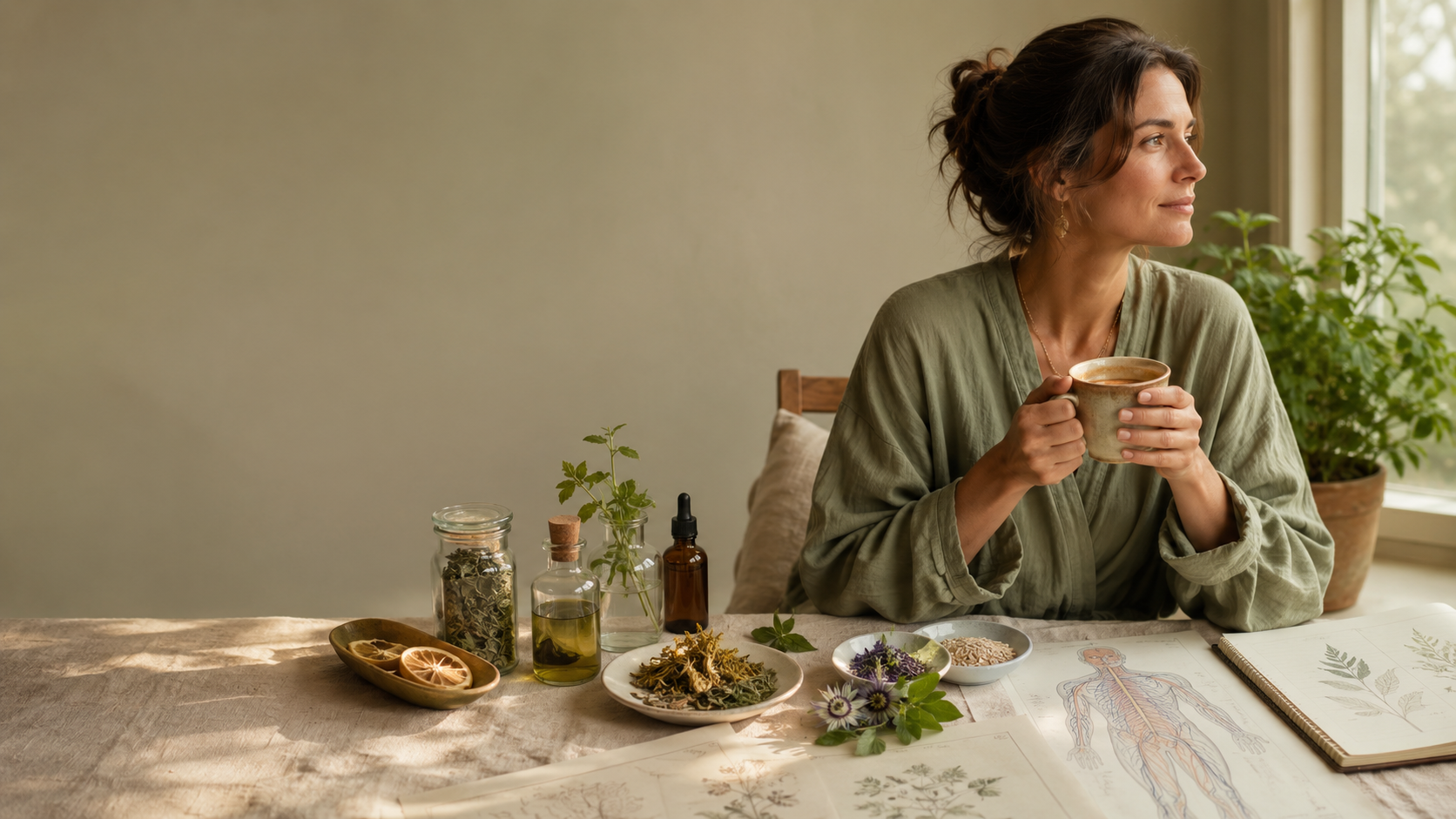
Lemon balm tea is one of the most soothing ways to take it, and the ritual of making a warm cup is itself a nervous system cue a signal to your body that it's safe to slow down. Steep high-quality dried lemon balm leaf for at least 5–10 minutes, covered, to preserve its volatile compounds. Mild, slightly lemony, and deeply comforting. A lovely morning or afternoon ritual.
As a Tincture
A tincture allows for more precise dosing and absorbs quickly into the bloodstream. This is a good option if you want more flexibility in how much you take or want to combine lemon balm with other herbs. A few drops in water works beautifully any time of day.
As a Capsule
Capsules offer consistency and convenience, a good fit for women who want a simple, no-preparation daily supplement. Look for a standardized extract that specifies rosmarinic acid content.
What to Pair Lemon Balm With for Deeper Nervous System Support
Lemon balm is wonderful on its own. But for women dealing with more significant burnout or deeper depletion, pairing it thoughtfully with other herbs creates much more comprehensive support.
Lemon balm + milky oats is one of the most classic combinations in nervine herbalism for nervous system exhaustion. Milky oats provide deep nourishment and rebuilding for depleted nerves over time, while lemon balm quiets the overactivation happening right now. Together they address both the depletion underneath and the dysregulation on the surface.
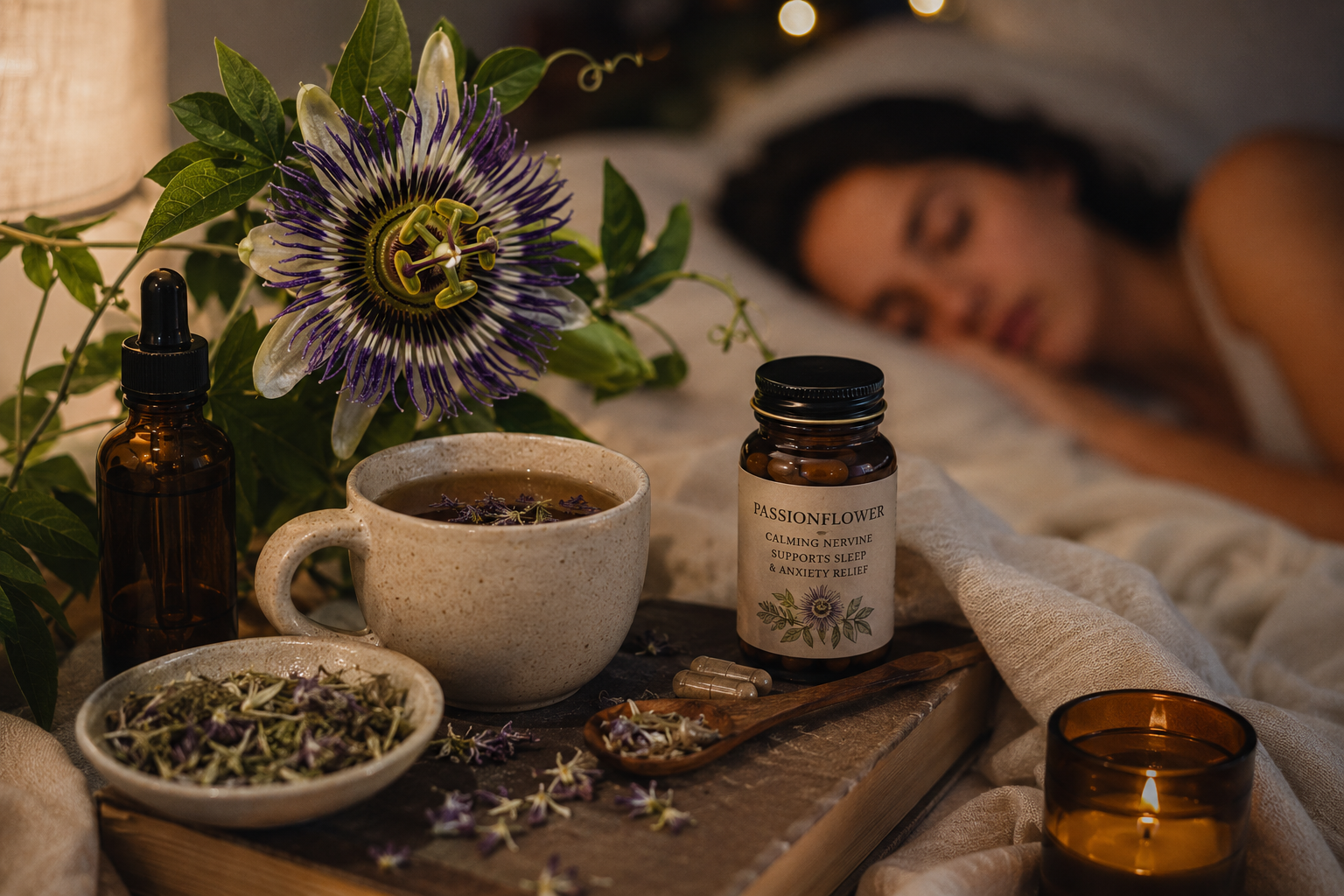
Lemon balm + passionflower works beautifully for the tired-but-wired pattern, particularly for sleep. Lemon balm handles daytime anxiety and the low-level buzzing feeling, while passionflower helps the mind finally release at night. This is one of the most beloved evening herbal combinations in existence for good reason.
Lemon balm + tulsi is a gentle, sustainable daily combination for stress resilience, gut support, and nervous system stability — especially lovely as an iced tea in summer.
Always introduce one herb at a time so you can notice how your body responds before adding more. Start low. Pay attention. Trust what you notice.
Your Nervous System Has Been Asking for This
You don't need to white-knuckle your way through healing. You don't need something stronger, more aggressive, or more complicated.
Sometimes the most powerful thing you can do is give your nervous system exactly what it's been quietly asking for, something gentle, something nourishing, something that says: you can slow down now. You're safe.
Lemon balm has been offering that to women for centuries. It's still doing it today.











Further Reading:
https://www.nccih.nih.gov/health/lemon-balm
https://pubmed.ncbi.nlm.nih.gov/17173170/
https://pubmed.ncbi.nlm.nih.gov/15378680/
https://pubmed.ncbi.nlm.nih.gov/31489067/
https://pmc.ncbi.nlm.nih.gov/articles/PMC8998198/
https://pmc.ncbi.nlm.nih.gov/articles/PMC7766837/
https://pmc.ncbi.nlm.nih.gov/articles/PMC8467360/
https://pmc.ncbi.nlm.nih.gov/articles/PMC10747739/
https://ods.od.nih.gov/factsheets/Magnesium-HealthProfessional/
https://pubmed.ncbi.nlm.nih.gov/31517876/