Passionflower for Sleep and Anxiety: How This Nervine Calms the Mind That Won't Shut Off at Night
You're exhausted. You've been exhausted all day. You could barely keep your eyes open through dinner.
And then you lie down, and your brain turns on.
The to-do list. The conversation you replayed three times. The thing you're worried about that you can't fix at 11pm. The thoughts that circle and circle without landing anywhere.
Your body is begging for sleep. Your mind has other plans. And no matter how tired you are, rest just won't come.
If this is you, you are not broken and you are not alone. This pattern has a name, tired but wired, and there is a gentle, well-loved herb that has been helping women with exactly this for centuries.
You're Exhausted but the Moment Your Head Hits the Pillow, Your Brain Turns On
The tired-but-wired pattern is one of the most common things that shows up in women dealing with burnout and nervous system dysregulation. And it makes complete sense physiologically, even though it feels maddening.
When your stress response has been running too hot for too long, your body loses its ability to smoothly shift gears from alert to rest. Your cortisol rhythm gets disrupted. Your nervous system stays stuck in a low-level state of activation even when you desperately need it to power down.
The result: physical exhaustion with mental hyperarousal. Your body wants off. Your brain hasn't gotten the memo.
What you need isn't a sedative that knocks you out. What you need is something that helps your nervous system make the transition it's struggling to make on its own. Something that quiets the mental noise gently, without a hangover, without dependency, without waking up feeling worse tomorrow.
That's exactly what passionflower does.
What Passionflower Is and How Long It's Been Used for Anxiety and Sleep
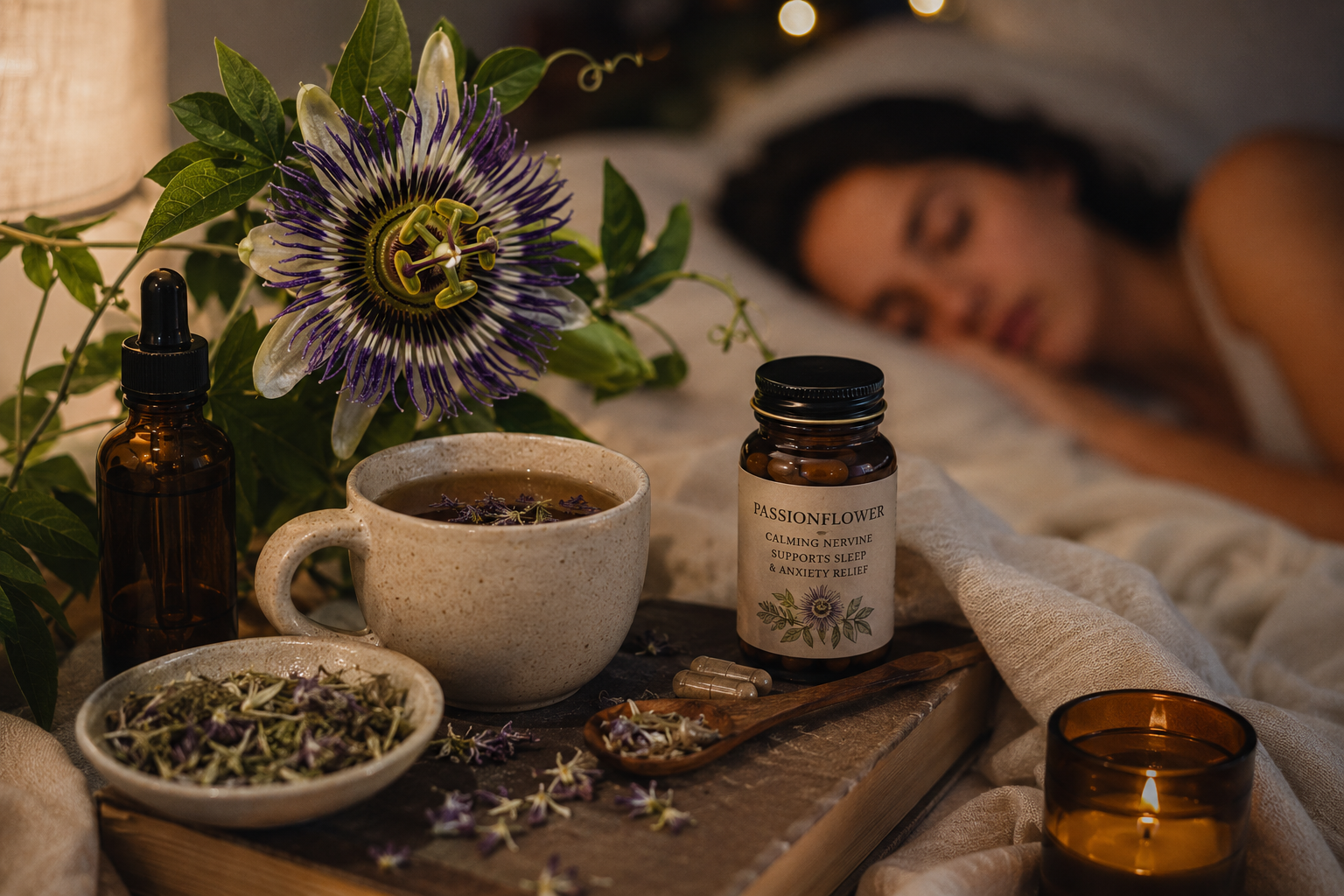
Passionflower (Passiflora incarnata) is a climbing vine native to the southeastern United States. It's hard to miss, its flowers are extraordinarily intricate, almost otherworldly in their beauty. Indigenous peoples used it for centuries as a calming and sleep-supporting remedy long before it made its way into formal herbal medicine.
Spanish physicians brought passionflower to Europe in the 1500s after learning of its traditional uses, and it quickly became one of the most valued nervines in both European and American herbalism. For hundreds of years it has been the go-to herb for anxiety, insomnia, nervous tension, and specifically the kind of racing, circular thinking that keeps people awake at night.
It is classified as a nervine sedative, meaning it calms and quiets the nervous system, with a particular affinity for slowing down an overactive, spinning mind. It does not knock you out. It coaxes your body into making its own relaxation.
What Passionflower Does in Your Body, And Why It Works for the Tired-but-Wired Pattern
Here's the science in plain language.
Your brain has a built-in calming system driven by a neurotransmitter called GABA (gamma-aminobutyric acid). GABA is your brain's natural brake pedal, it counters overstimulation, quiets overexcited neurons, and creates the internal conditions necessary for relaxation and sleep.
When you're burned out or chronically stressed, this system gets dysregulated. Your brain produces less GABA or uses it less efficiently. The accelerator stays pressed even when you want to stop.
Passionflower works by binding to GABA receptors in the brain, enhancing GABA's calming effect. Its active compounds, particularly flavonoids like vitexin and chrysin, modulate these receptors in a way that promotes relaxation without the harsh sedation of pharmaceutical sleep aids.
Research shows passionflower can reduce the time it takes to fall asleep, improve overall sleep quality, increase total sleep time, and reduce nighttime awakenings. One clinical trial found passionflower showed anxiolytic effects comparable to a pharmaceutical sedative, with significantly fewer side effects.
Crucially, it also supports the adrenals by encouraging truly restorative sleep. And when your adrenals can rest at night, everything, energy, mood, stress tolerance, hormone balance, starts to shift.
Signs Passionflower Might Be Exactly What You Need Right Now
Not every herb is right for every person at every stage of healing. Passionflower tends to be especially helpful if you recognize yourself in these patterns:
You fall asleep fine but wake at 2 or 3am with a racing mind
You're exhausted all day but feel a "second wind" kick in right when you want to sleep
Your anxiety feels more mental than physical — lots of circular thinking, rumination, replaying
You carry tension in your jaw, neck, or shoulders, especially at night
Stress shows up in your digestion — nervous stomach, spasms, or cramping
You feel wired after emotionally intense days even when your body is done
You've tried melatonin and it either doesn't work or leaves you groggy
You're sensitive to stronger herbs or medications and need something gentle
Passionflower is also particularly well suited for highly sensitive women and those in burnout recovery because it works with your body's own chemistry rather than overriding it.
Top Supplements to Ease Dopamine Imbalance, Burnout, and Overstimulation
How to Use Passionflower: Tea, Tincture, or Capsule
Passionflower is most effective when taken in the evening, about 30–60 minutes before bed. Here's how each form works:
As a Tea
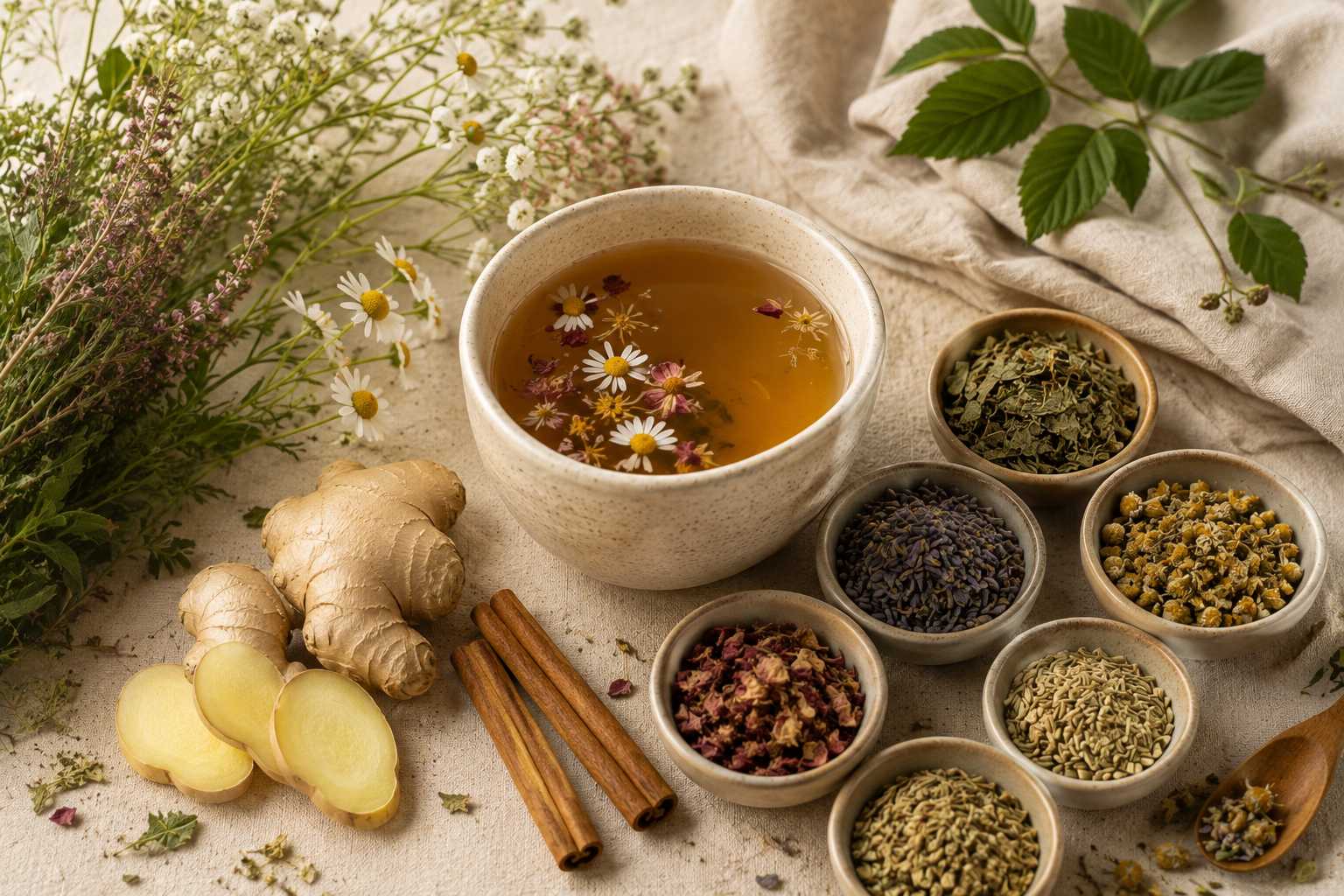
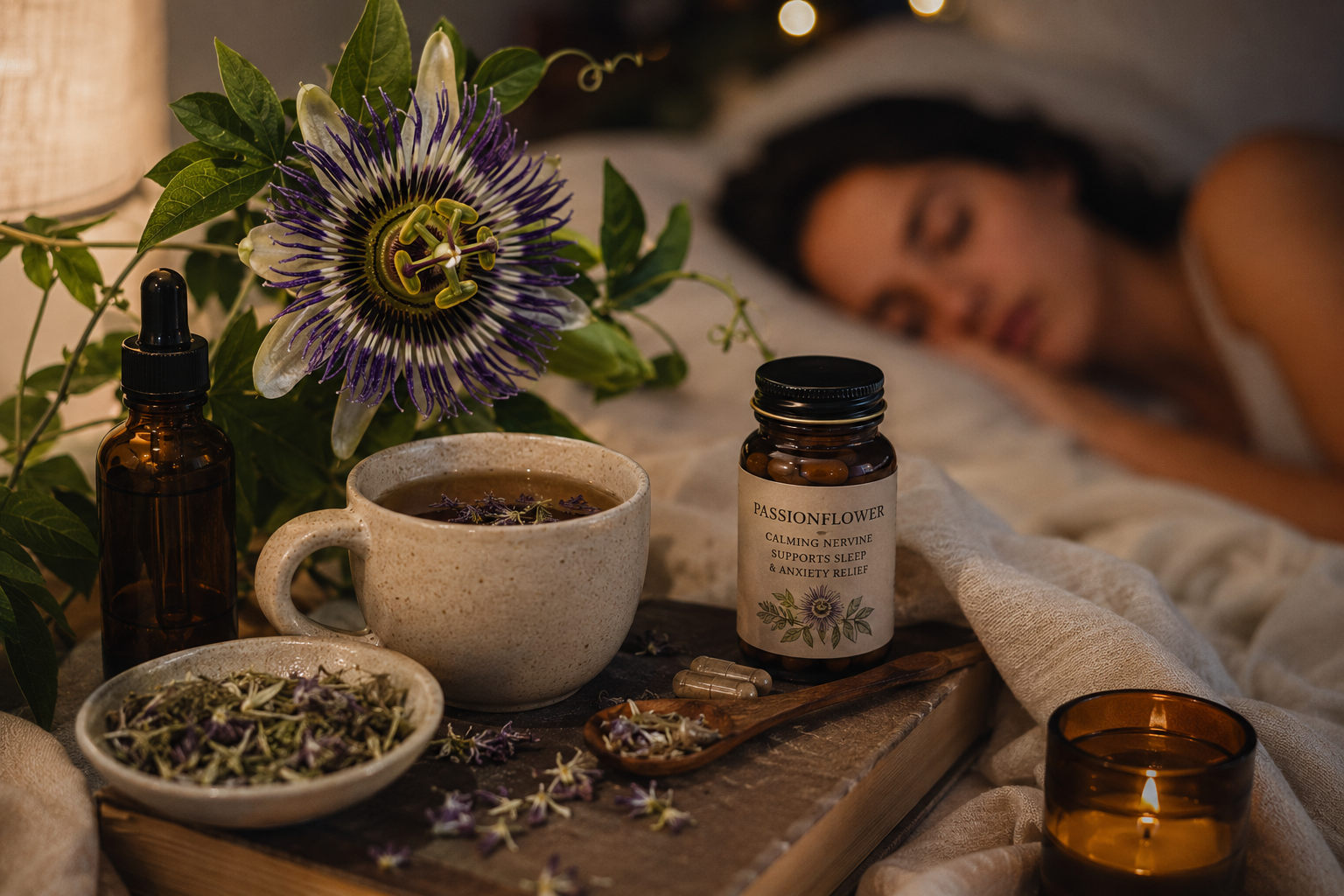
Passionflower tea is one of the most beloved evening rituals in herbal medicine. The act of making and drinking a warm cup before bed is itself a nervous system cue, a signal to your body that it's time to slow down. Look for high-quality dried passionflower herb and steep for 10–15 minutes, covered, to preserve the volatile compounds. The taste is mild and slightly earthy.
As a Tincture
A tincture allows for more precise dosing and absorbs quickly. This is a good option if you want flexibility in how much you take or want to combine it with other herbs like lemon balm for a layered effect. A few drops in warm water in the evening works beautifully.
As a Capsule
Capsules offer convenience and consistent dosing, a good fit if you want a simple, no-prep nightly supplement. Look for standardized Passiflora incarnata extract.
What to Combine Passionflower With for a Full Sleep and Nervous System Protocol
Passionflower is wonderful on its own. But for women dealing with deeper burnout or more significant sleep disruption, thoughtful combinations can take things much further.
Passionflower + lemon balm is one of the most classic and well-loved pairings in nervine herbalism. Lemon balm eases daytime anxiety and that low-level buzzing feeling, while passionflower handles the nighttime mental activation. Together they support the full arc from stress to sleep. Many herbal tinctures and teas combine them for exactly this reason.
Passionflower + milky oats addresses both the acute sleep difficulty and the deeper nervous system depletion underneath. Milky oats nourish and rebuild the frayed nervous system over time while passionflower provides more immediate evening relief.
Passionflower + magnesium glycinate is a combination many functional practitioners recommend for sleep. Magnesium supports GABA function and muscle relaxation, making it a natural complement to passionflower's action. Together they address multiple pathways involved in the tired-but-wired pattern.
Start with one at a time. Notice how your body responds. Build slowly.
Your Mind Is Allowed to Rest
You have been working so hard. Carrying so much. Running on so little.
Your mind racing at night is not anxiety that you just need to push through. It is your nervous system stuck in a pattern it doesn't know how to get out of, and it needs help making the shift.
Passionflower has been offering that help for centuries. It doesn't force anything. It doesn't sedate you into oblivion. It simply whispers to your nervous system that it's safe to slow down now. That the day is done. That rest is allowed.