


There are over 90,000 dietary supplement products currently available in the United States market. Almost none of them have been reviewed by the FDA before they reached the shelf you found them on.
That is not a reason to avoid supplements entirely. Many of the women in this community genuinely benefit from well-chosen, well-formulated supplements. The research supporting specific nutrients for sleep, nervous system regulation, hormone balance, gut health, and energy is real and growing.
But the supplement market is one of the least regulated consumer spaces in existence. And that means the difference between a supplement that works and one that does nothing, or worse, one that contains something harmful, often comes down to decisions you have to make yourself before you buy anything.
This post is my complete evaluation framework. Every supplement recommended on Bloomin' Well has passed this list. I am sharing it with you so you can apply it yourself, to anything I recommend and to everything you already own.
The Regulation Problem You Need to Understand
Before we get into the checklist, you need to understand the foundational issue.
Prescription medications must be proven safe and effective before the FDA approves them for sale. Dietary supplements do not. The FDA does not evaluate supplement safety or quality before products reach the market. Manufacturers are responsible for ensuring their products are safe and that claims are truthful, but there is no pre-market approval process and no requirement to demonstrate efficacy.
This means that when you buy a supplement, you are trusting the manufacturer's claim that the product contains what the label says, in the amount the label states, without contaminants. Many manufacturers honor that trust. Many do not. Independent testing of commercially available supplements has found products that contain none of the active ingredient listed, products contaminated with heavy metals, mold, pesticides, or unlisted pharmaceutical compounds, and products with ingredient amounts that bear no relationship to what the label claims.
This is not a fringe problem. It is a systematic feature of an unregulated market.
The solution is not to avoid supplements. It is to know exactly what to look for and what to avoid before you hand over your money and put something into your body.
The 12 Things I Check Before I Recommend Anything
1. Third-Party Testing With a Named Certification
This is the single most important thing on this list. Third-party testing means an independent organization, with no financial relationship to the manufacturer, has tested the product and verified that it contains what it says and is free from contaminants.
The certifications that matter most:
NSF International offers NSF Certified for Sport, which verifies ingredient accuracy, absence of banned substances, and manufacturing quality. NSF also certifies non-sport supplements. This is one of the most rigorous certifications available.
USP Verified means the United States Pharmacopeia has tested the product for ingredient identity, potency, and purity. USP verification requires that the product disintegrates properly so the ingredients can actually be absorbed.
Informed Sport and Informed Choice screen for banned substances and verify ingredient accuracy. Widely used in practitioner-grade brands.
ConsumerLab independently tests supplements and publishes their findings. Products that pass ConsumerLab testing can display their seal.
A product without any third-party certification is not automatically bad. Some excellent smaller brands do batch-specific testing without carrying a branded seal. But the certification seal is the fastest and most reliable quality signal available to a consumer without access to a laboratory.
What I do not accept as evidence of quality: a company saying their products are tested without naming the testing organization, or a company saying they do internal testing. Internal testing is not the same as independent third-party verification.
2. The Specific Form of Each Nutrient Is Named
The form of a nutrient is not a minor detail. It determines how much of what you swallow your body can actually use.
Magnesium oxide absorbs at roughly 4%. Magnesium glycinate absorbs at rates that are many times higher and is gentle on the digestive system. If a label just says "magnesium" without specifying the form, that is a transparency problem.
Vitamin B12 as cyanocobalamin requires your body to convert it before it can be used. Methylcobalamin is already in the active form. Women with MTHFR variants or impaired methylation often cannot make this conversion efficiently, meaning cyanocobalamin is largely wasted.
Folate as folic acid requires conversion to the active form. Women with MTHFR variants benefit significantly from the already-active methylfolate or folinic acid forms instead.
Iron as ferrous sulfate causes constipation in most women who take it. Iron bisglycinate absorbs better and causes significantly less digestive upset.
The form tells you what the manufacturer actually invested in. A product using the most bioavailable forms costs more to produce. A product using the cheapest forms passes that savings to the manufacturer, not to your health.















3. The Elemental Dose Is Clearly Listed
This one trips up even careful supplement shoppers.
A label might say "magnesium glycinate 400 mg." That sounds like 400 mg of magnesium. But the 400 mg refers to the total weight of the compound, including the glycine molecules it is bound to. The actual elemental magnesium in that capsule might be 50 to 60 mg. If the research supporting magnesium for sleep used 250 mg of elemental magnesium and you are taking a product providing 50 mg per capsule, you are not taking anywhere near a meaningful dose even if you follow the label directions.
Quality products list both the compound weight and the elemental amount clearly. If you cannot figure out the elemental dose from the label, the product is not being transparent enough to earn your purchase.
4. No Proprietary Blends
A proprietary blend is a group of ingredients listed together under a single total weight, with no individual amounts disclosed. You might see something like "Stress Support Blend 450 mg" followed by a list of five herbs. You have no idea whether the most important herb in that blend is present at a therapeutic dose or at a token amount included to justify its presence on the label.
This is one of the most common marketing strategies in the supplement industry. It allows companies to put impressive-sounding ingredient lists on their labels while potentially including most of those ingredients at amounts far below what any research has used.
I do not recommend products with proprietary blends. If a company will not tell you how much of each ingredient is in the product, that company is not being transparent enough to deserve your trust.
5. The Other Ingredients List Is Short and Clean
The other ingredients section is where fillers, binders, flow agents, coatings, colors, and preservatives appear. These are the ingredients that make manufacturing easier but have nothing to do with the therapeutic purpose of the product.
Some of these are benign. Vegetable cellulose capsules, for example, are a clean and appropriate excipient. Others are worth avoiding.
Titanium dioxide is a whitening agent used in some supplements. It has been flagged for potential adverse effects on gut barrier integrity and is banned as a food additive in the European Union.
Artificial colors are unnecessary in any supplement and serve only an aesthetic purpose. They can trigger reactions in sensitive individuals and contribute to overall chemical burden.
Silicon dioxide is a common flow agent. In small amounts it is likely benign for most people, but it is an unnecessary additive that better-formulated products do not need.
Magnesium stearate is a common lubricant used in tablet manufacturing. Its health implications are debated, but the best practitioner-grade manufacturers have largely moved away from it.
The goal is a short, recognizable list. If you cannot identify what most of the other ingredients are or why they are there, that is worth paying attention to.
6. No Artificial Colors or Sweeteners
Artificial colors and sweeteners are completely unnecessary in any supplement intended for a health-supporting purpose. Their presence tells you something about the manufacturer's priorities. A supplement designed to support a reactive, sensitive, or health-focused body has no business containing Red 40, Yellow 5, or sucralose.
This matters especially for women with histamine intolerance, MCAS, or chemical sensitivity. Some artificial dyes and flavors are known mast cell triggers. Even for women without those sensitivities, artificial additives are an unnecessary burden.
7. GMP-Certified Manufacturing
GMP stands for Good Manufacturing Practices. The FDA requires that dietary supplement manufacturers follow GMP regulations, but the level of enforcement varies significantly. Independent GMP certification from organizations like NSF, UL, or the Natural Products Association adds a layer of verification that the manufacturing facility actually meets current quality standards.
GMP certification means the facility has systems in place for ingredient verification, batch testing, contamination prevention, and documentation. Products manufactured in GMP-certified facilities are significantly more likely to contain what the label says in the amount stated.
8. Claims Are Specific and Realistic
The front of a supplement label cannot legally claim to diagnose, treat, cure, or prevent any disease. What it can say is things like "supports healthy sleep" or "promotes immune function." These structure-function claims are legal and often appropriate.
What should make you skeptical: extraordinary claims that imply the product does something a single supplement cannot plausibly do. "Reverses aging." "Eliminates brain fog forever." "Melts belly fat." These claims are not based in credible science. They are marketing. A company willing to make extravagant claims on the front of the label may be equally willing to cut corners on the back.
Good supplements make claims that are proportional to what the evidence actually shows. Conservative, specific, honest claims on a supplement label are actually a positive quality signal.


9. For Probiotics: The Strain Is Named
As covered in the probiotics post, strain designation is everything in probiotic quality. A product that lists Lactobacillus rhamnosus without a strain designation tells you nothing meaningful about which version of that organism you are getting or whether it has been studied for your concern.
Quality probiotic products name the full strain, including the genus, species, and strain code. They list CFU count at time of expiry rather than at time of manufacture, because the number that matters is how many live bacteria reach your gut, not how many were present when the product was made.
10. An Expiration Date Is Printed on the Packaging
This sounds basic. It is not always present. Supplements degrade over time. Probiotics lose live bacteria. Fish oil oxidizes. Fat-soluble vitamins lose potency. An expiration date tells you the manufacturer has established stability testing and is willing to commit to a shelf life. Its absence is a transparency gap.
Check the expiration date before you buy. If a product is near expiry, the potency may already be declining. If there is no expiration date at all, put it back. In recent years, many manufacturers are no longer including expiration dates, but are including a date of manufacture. Contacting the company will allow you to ask how long that specific product’s shelf life is.
11. A Certificate of Analysis Is Available
A certificate of analysis, or COA, is a document from a testing laboratory showing the results of quality testing for a specific batch of product. It confirms that the ingredients were present at the stated amounts and that contaminants were tested for and not found above acceptable limits.
Reputable manufacturers make COAs available on their websites or upon request. The absence of a COA does not automatically mean a product is poor quality. But its presence, especially when the COA is from an independent third-party laboratory rather than the manufacturer's own testing, is a meaningful quality signal.
12. You Actually Need This Supplement
This is the one most supplement articles never include. And it is the most important.
The best quality supplement in the world is still the wrong choice if you do not actually need it. Supplementing without knowing your baseline status means you might be adding nutrients you have adequate amounts of, missing the nutrients you are actually depleted in, or spending money on products that cannot address the root cause of your symptoms.
Testing before supplementing gives you a baseline. Ferritin, vitamin D, vitamin B12, magnesium RBC, and a hormone panel are among the most useful tests for identifying the nutritional deficiencies most commonly driving symptoms in the women in this community.
If you cannot test, use symptoms as your guide and introduce one supplement at a time so you can actually identify what is helping. A woman taking seven supplements simultaneously has no way of knowing which one is making a difference.
Read more: How to Read Your Own Labs
The Red Flags: What Makes Me Put Something Back
Some things are immediate disqualifiers regardless of how good the rest of the product looks.
The word "proprietary blend" on the label with no individual amounts disclosed.
Artificial colors listed in the other ingredients, particularly Red 40, Blue 1, Yellow 5, or titanium dioxide.
No third-party testing mentioned anywhere on the label or website.
Extraordinary claims that promise to cure, reverse, or eliminate conditions that no supplement can address on its own.
A CFU count listed only at time of manufacture for a probiotic, without any mention of expiry stability.
An ingredient list where the form of the active nutrient is not specified.
A website or label that provides no information about manufacturing practices or sourcing.
Why Expensive Does Not Always Mean Better
Price is not a reliable quality indicator in the supplement market. Some of the most expensive products on the market use proprietary blends, cheap nutrient forms, and significant marketing budgets that have nothing to do with what is in the bottle.
Price tends to correlate with quality when it reflects the use of more bioavailable nutrient forms, more rigorous testing, and more transparent sourcing. It does not correlate with quality when it reflects brand recognition, influencer marketing, or premium packaging.
A modestly priced, third-party certified magnesium glycinate from a transparent manufacturer is a better purchase than an expensive "comprehensive stress formula" with a proprietary blend and no third-party testing.
Evaluate based on the criteria above. Not the price tag.
Why Cheap Does Not Always Mean Worse
The reverse is also worth saying. Some well-established supplement brands produce excellent quality products at accessible price points. Creatine monohydrate from a third-party tested manufacturer is inexpensive and high quality. Fish oil from a reputable brand with an IFOS certification for purity does not need to cost $80 a bottle to be worth taking.
The supplement industry wants you to equate price with quality because it is profitable. Your checklist protects you from that equation in both directions.
What Fullscript Is and Why I Use It
Fullscript is a professional supplement dispensary platform used by healthcare practitioners. It carries practitioner-grade supplement brands that have agreed to meet quality standards above what is typically required of retail supplements.
Products on Fullscript are not automatically perfect. But the barrier to entry for brands on the platform is meaningfully higher than for products on Amazon or in a general health food store. Many of the brands I recommend most consistently, including Thorne, Pure Encapsulations, Designs for Health, Klaire Labs, Seeking Health, and Nordic Naturals, are available through Fullscript and meet the criteria on this list.
When I link to Fullscript in a post, it is because the product meets my quality criteria, not because it is the most expensive option or because the platform pays me to recommend it. Every recommendation on Bloomin' Well is chosen for clinical appropriateness first.
Shop Bloomin' Well recommended supplements here →
How to Audit the Supplements You Already Own
Take out everything you are currently taking. Run each one through this list.
Check the other ingredients for titanium dioxide, artificial colors, and unnecessary additives. Look for a third-party testing seal. Find the specific form of each active nutrient. Confirm that elemental doses are listed clearly. Look for proprietary blends. Check the expiration date.
For anything that fails multiple points on this list, decide whether the supplement is actually addressing a documented need for you. If it is, find a better-formulated version that meets these standards. If it is not, consider whether you need it at all.
Most women who do this audit find that two or three of their supplements are worth keeping or upgrading, a few are unnecessary, and one or two may have been working against them with poor forms or unnecessary additives.
That is not a failure. That is information. And information is what allows you to make better choices going forward.
The Bottom Line
The supplement market has over 90,000 products and almost no meaningful pre-market regulation. That makes you your own quality control, whether you want to be or not.
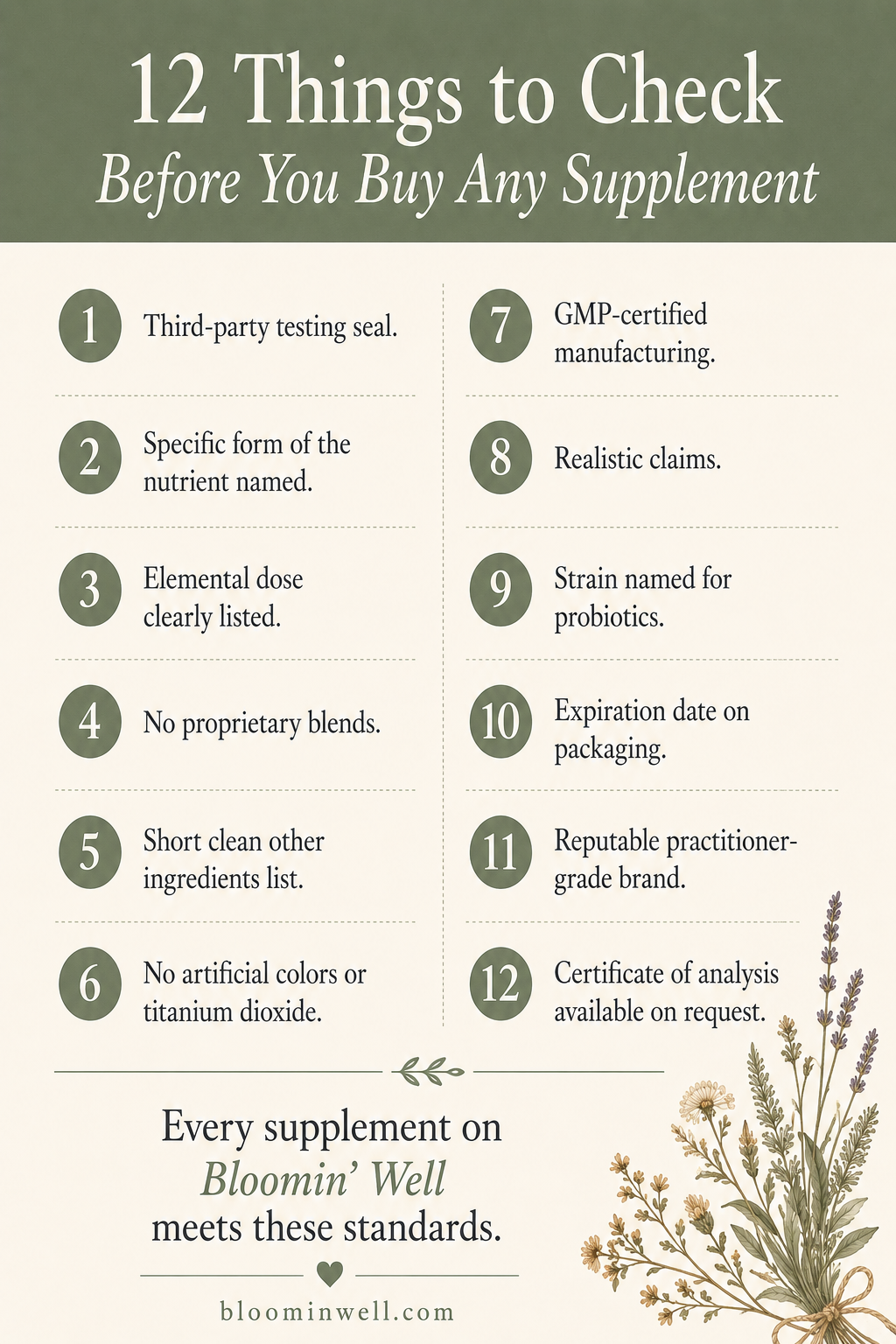
The 12 criteria on this list, third-party testing, named nutrient forms, clear elemental dosing, no proprietary blends, clean other ingredients, no artificial colors, GMP manufacturing, realistic claims, strain designation for probiotics, expiration dating, certificate of analysis availability, and actual need, give you a practical framework for evaluating any supplement before you buy it and for auditing what you already own.
Every supplement recommended on Bloomin' Well passes this list. That is not marketing. It is a clinical standard I apply because the women in this community have bodies that are already under enough pressure. The supplements you take should be part of the support, not part of the burden.
Read more: Magnesium Glycinate for Women
Read more: Probiotics vs Prebiotics vs Postbiotics
Read more: Supplements for Sensitive Bodies
Sources
Healthline. How to Choose High-Quality Vitamins and Supplements. Updated May 2026. https://www.healthline.com/nutrition/how-to-choose-high-quality-vitamins-and-supplements
GoodRx. Pharmacist-Backed Tips for Choosing High-Quality Supplements. August 2026. https://www.goodrx.com/well-being/supplements-herbs/how-to-know-if-youre-buying-a-good-supplement-brand
National Center for Complementary and Integrative Health. 5 Tips: What Consumers Need to Know About Dietary Supplements. NIH. 2026. https://www.nccih.nih.gov/health/tips/things-to-know-about-dietary-supplements
Infinity Wellness. What to Look for When Choosing a Trustworthy Supplement. July 2026. https://liveinfinitywellness.com/blogs/news/what-to-look-for-when-choosing-a-trustworthy-supplement
Nutrition by Bre. Third-Party Tested Supplements: Dietitian's List of NSF and USP-Verified Picks. 2026. https://www.nutritionbybre.com/blog/third-party-tested-supplements-dietitian
U.S. Food and Drug Administration. Questions and Answers on Dietary Supplements. https://www.fda.gov/food/information-consumers-using-dietary-supplements/questions-and-answers-dietary-supplements
Office of Dietary Supplements. Dietary Supplements: What You Need to Know. NIH. https://ods.od.nih.gov/factsheets/WYNTK-Consumer/
NSF International. Supplement and Vitamin Certification. https://www.nsf.org/services/by-type/dietary-supplements
United States Pharmacopeia. Choosing a Quality Supplement. https://www.usp.org/verification-services/usp-verified-dietary-supplements
iHealth Unified Care. How to Find High-Quality Supplements Since They Are Not FDA-Regulated. November 2025. https://www.ihealthunifiedcare.com/articles/how-to-find-high-quality-supplements-since-theyre-not-fda-regulated